Structured home practice sessions produce faster, more reliable improvement than unplanned hitting because they build automaticity and direct deliberate practice toward your actual weaknesses. Pick one measurable metric tonight, choose a short, focused template, and record one data point. That's the whole system in its simplest form.
Here's what to do right now:
- Choose one specific goal (e.g., "reduce lateral dispersion with 7-iron to under 15 feet")
- Set a 15–30 minute timer and divide it: 5 min warm-up, 15 min focused block, 5 min review
- Record one metric after the session: miss pattern, carry distance, or perceived difficulty
- Stage your equipment the night before so startup friction disappears
- Use Sim2coursecaddie to import shot data and visualize trends without manual logging
Table of Contents
- Why home practice sessions need structure: the science behind it
- What does an effective session actually look like?
- How to design your own structured session step by step
- Common mistakes that unstructured practice makes worse
- How to make structured sessions a habit that actually sticks
- What to record each session and how to use it
- How Sim2coursecaddie supports structured practice
- Ready-to-run session templates
- Key Takeaways
- The part most golfers skip
- Sim2coursecaddie makes the measurement step effortless
- Useful sources and further reading
Why home practice sessions need structure: the science behind it
The brain doesn't improve through repetition alone. It improves through targeted repetition with feedback. That's the core of what K. Anders Ericsson called Deliberate Practice: structured activities designed to address specific performance gaps, with immediate corrective feedback. Random hitting reinforces whatever you already do, including your faults.
Automaticity is the goal. When a sequence becomes automatic, the brain runs it with far less cognitive effort, freeing attention for the parts that actually need it. A fixed session structure reduces decision fatigue and lets you enter focused states faster because you're not spending mental energy deciding what to do next.
Decision fatigue is real and underappreciated. Every choice you make during a session, "Should I hit drivers or irons? How many reps? What am I working on?" burns prefrontal resources that belong to learning. A preset sequence eliminates those micro-decisions before you even pick up a club.
Research on skill acquisition reinforces this: practice quality, optimal challenge, and specificity to real playing conditions matter more than raw volume. Structure is what delivers all three.
What does an effective session actually look like?
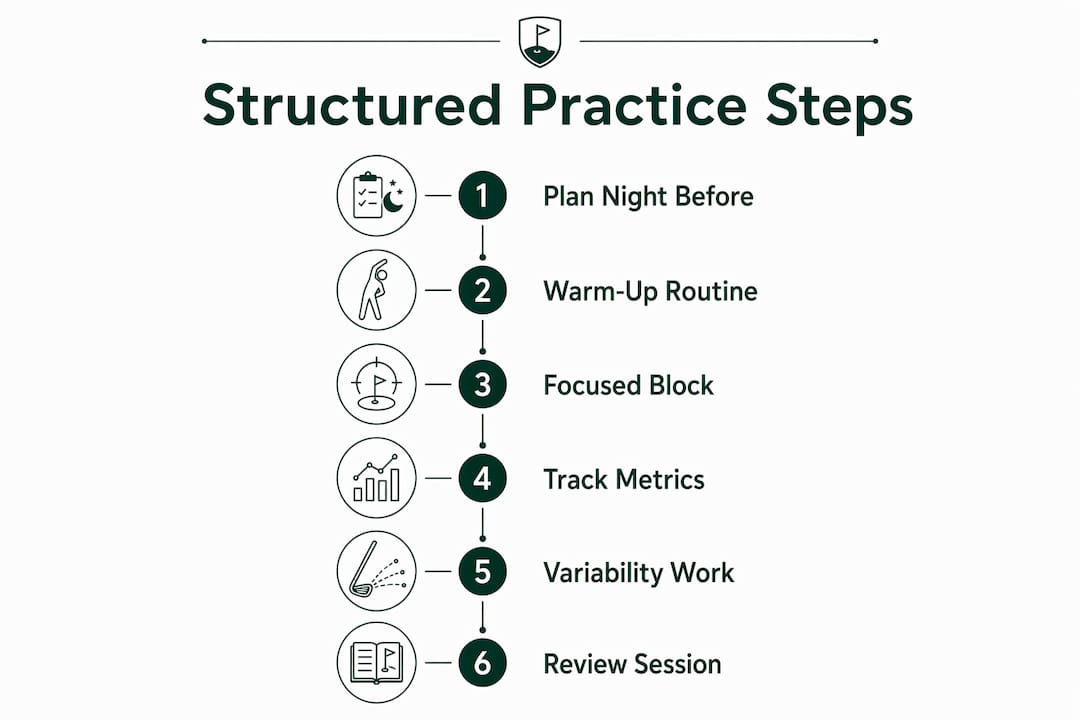
Every productive home session follows the same sequence, regardless of length:
- Ritual/cue: A consistent trigger (same playlist, same warm-up stretch) that signals "practice mode" to your brain
- Warm-up: Easy, familiar shots to get the body moving and attention focused, not a time to fix anything
- Focused technical block: One specific goal, worked deliberately with full attention
- Targeted reps with measurement: Track your chosen metric across a defined number of attempts
- Variability/pressure work: Change targets, add a consequence, or simulate a course scenario
- Cooldown and session note: Two minutes to write what happened and what to work on next
Order matters. Warm-up primes attention. The focused block loads difficulty at the right moment. Variability work comes after the pattern is somewhat grooved, not before. Skipping straight to pressure reps before the technical block is one of the most common mistakes golfers make at home.
Pro Tip: Phrase your focused-block goal as a single measurable sentence: "Hit 20 balls with the 6-iron and keep 80% within a 10-foot lateral window." Vague goals like "work on my irons" produce vague results.

How to design your own structured session step by step
The night before: Write down one specific, measurable focus. Not "work on distance control" but "hit 7-iron targets at 150 yards and record carry variance." This single act prevents the hesitation that kills session quality before it starts.
Choose your time budget and map components to it:
| Session Length | Warm-Up | Focused Block | Measurement Reps | Variability | Review |
|---|---|---|---|---|---|
| 20–30 min | 5 min | 15–30 min | 5 min | — | 3 min |
| 45–60 min | 5 min | 20–30 min | 10 min | 10 min | 5 min |
| 90 min | 10 min | 30 min | 15 min | 15 min | 10 min |
Select one primary metric for the session goal: dispersion (lateral miss pattern), average carry distance, error type (fat/thin/heel/toe), or perceived difficulty on a 1–10 scale.
Pre-session setup checklist:
- Clubs and mat in position
- Launch monitor or simulator powered on
- Balls staged and ready
- Session goal written down
- Timer set
Common mistakes that unstructured practice makes worse
Most golfers who practice at home aren't wasting time because they lack effort. They're wasting it because the format works against learning.
- "Just hitting" without a target: Reinforces existing patterns, including the ones causing your bad shots. No feedback loop means no correction.
- Binge sessions: Long, unfocused sessions create cognitive overload and negative associations with practice. Shorter, high-intensity blocks produce better retention and keep you coming back.
- Poor environment setup: When gear isn't ready, the startup cost feels high enough to skip the session entirely. Friction is the enemy of consistency, not motivation.
Structure fixes each of these directly. A defined goal replaces aimless hitting. A time cap prevents overload. A staged environment removes the excuse.
Pro Tip: A 15-minute structured session beats a 90-minute wandering one every time. If you only have 15 minutes, use the short template. Don't skip because you "don't have enough time."
How to make structured sessions a habit that actually sticks
The three main reasons home practice fails are lack of structure, physical discomfort, and mental resistance, according to practitioner analysis. None of those are willpower problems. They're design problems.
Set an obvious environmental cue: clubs out, mat down, simulator on. When the space is ready, the decision to practice is already half made. Keeping equipment staged and accessible is one of the highest-leverage changes you can make. It's also one of the easiest.
Attach the session to something you already do: right after dinner, right after work, first thing in the morning. The anchor habit carries the new one. Add a small ritual, the same stretch, the same two warm-up swings, and your brain starts treating it as a sequence rather than a decision. Documenting sessions adds another layer of accountability that keeps the habit alive past the first week.
Pro Tip: Prepare your session goal and equipment the night before. Morning resistance is highest; removing setup friction the evening before means the session starts before your brain has time to negotiate.
What to record each session and how to use it
Tracking one metric per session keeps feedback simple and prevents analysis paralysis. Here's what to record:
- Target: What you were aiming at and the distance
- Rep count: Total attempts in the focused block
- Dispersion: Left/right miss pattern and spread
- Average carry: Actual vs. intended distance
- Error type: Fat, thin, heel, toe, or directional
- Perceived difficulty: 1–10 scale for the session goal
| Goal | Best Metric to Track |
|---|---|
| Alignment | Lateral dispersion (left/right miss pattern) |
| Distance control | Average carry vs. target carry |
| Trajectory | Launch angle and apex height |
| Consistency | Error type frequency across rep set |
| Pressure performance | Perceived difficulty score under simulated conditions |
One week of data tells you more than a month of untracked hitting. If your miss pattern shifts left three sessions in a row, that's your next focused block. Tracking misses reveals root causes that feel patterns alone never surface. Convert weekly trends into the next session's single focus, and the system compounds.
How Sim2coursecaddie supports structured practice
Deliberate practice depends on immediate, specific feedback. The longer the gap between action and correction, the slower the learning. Sim2coursecaddie closes that gap.
Here's how it fits the session workflow:
- Set your metric before the session (dispersion, carry, error type)
- Run your focused block on any simulator
- Import shot data directly into Sim2coursecaddie
- Review the 3D driving-range visualization to see miss patterns clearly
- Check the session log and adjust next session's focus from the trend
Sim2coursecaddie provides automated performance tracking without manual logging, keeps a historical record across sessions, and surfaces trends you'd miss reviewing one session at a time. It works with any simulator and costs nothing, which removes the last excuse for skipping the measurement step.
Ready-to-run session templates
20–30 minute template
| Block | Time | Activity | Metric to Record |
|---|---|---|---|
| Warm-up | 5 min | Easy irons, familiar targets | None |
| Focused drill | 15–30 min | One specific technical goal | Dispersion or error type |
| Measurement set | 5 min | 10 reps, same target | Average carry |
| Review | 3 min | Session note, one observation | Perceived difficulty |
45–60 minute template
| Block | Time | Activity | Metric to Record |
|---|---|---|---|
| Warm-up | 5 min | Progressive clubs, easy targets | None |
| Technical block | 20–30 min | Isolated drill, full attention | Dispersion |
| Scenario reps | 10 min | Simulated course situation | Error type |
| Variability | 10 min | Random targets, club changes | Perceived difficulty |
| Review | 5 min | Session log, next focus | Trend note |
90 minute template
| Block | Time | Activity | Metric to Record |
|---|---|---|---|
| Warm-up | 10 min | Full progressive warm-up | None |
| Focused block 1 | 30 min | Primary technical goal | Dispersion + carry |
| Scheduled break | 5 min | Rest, hydrate | None |
| Focused block 2 | 15 min | Secondary goal or same drill, higher pressure | Error type |
| On-course pressure | 15 min | Simulated hole scenarios | Perceived difficulty |
| Full review | 10 min | Session log, trend analysis, next session goal | All metrics |
Minimal equipment: mat, net or simulator, one club. Optional extras: launch monitor, alignment sticks, impact tape.
Key Takeaways
Structured home practice sessions build automaticity, target real weaknesses, and produce measurable improvement that unplanned hitting simply cannot match.
| Point | Details |
|---|---|
| Keep sessions short and specific | A 15–30 minute focused session outperforms a long, aimless one every time. |
| Decide the focus the night before | Writing one measurable goal in advance eliminates hesitation and raises session quality. |
| Track one primary metric | Record dispersion, carry, or error type each session and use weekly trends to set the next focus. |
| Stage your environment | Equipment ready before the session removes friction and dramatically increases consistency. |
| Use Sim2coursecaddie | Import shot data, visualize miss patterns, and track trends across sessions for free. |
The part most golfers skip
Most golfers treat home practice as a volume problem. Hit more balls, get better. The research says otherwise, and so does anyone who has spent serious time on a simulator.
The real gap isn't reps. It's the absence of a feedback loop. You can hit 200 balls in a session and leave with a more ingrained version of the same fault you walked in with. Structure forces you to confront what's actually broken, not just repeat what's comfortable. That's uncomfortable, which is exactly why most people avoid it.
The other thing worth saying: self-directed structured practice has a ceiling. When your session data shows the same miss pattern for three or four weeks and your adjustments aren't moving it, that's the signal to bring in a coach. Structured practice accelerates coaching because you arrive with documented evidence of the problem, not just a vague complaint about your ball flight. The session review process becomes the briefing document for every lesson.
Start with a short template. Track one metric. Repeat sessions regularly. The data will tell you what to do next better than any general advice can.
Sim2coursecaddie makes the measurement step effortless
Structured sessions only compound when you can see the trend across weeks, not just remember last Tuesday's session. Sim2coursecaddie gives you that historical record without any manual logging.

Import shot data from any simulator, pull up the 3D driving-range view to see exactly where your misses cluster, and check your session log to confirm whether this week's dispersion is tighter than last week's. The free analytics cover everything the templates above require: dispersion, carry, error type, and trend tracking across sessions. No subscription, no hardware requirement. Just the data your structured sessions generate, organized so you can actually use it. Open the app after your next session and import your first round of shot data.
Useful sources and further reading
- Deliberate Practice: The Key to Expert Skill Development — Psychology Today: supports the Deliberate Practice framework and the value of immediate feedback in skill acquisition.
- Is the Deliberate Practice View Defensible? — Frontiers in Psychology: peer-reviewed meta-analysis of deliberate practice research; useful for understanding the evidence base and its limits.
- How to Structure a Music Practice Session — Sarah Stumboeck: practitioner guide on session templates, decision fatigue, and the value of pre-defining goals; directly supports the templates and how-to sections.
- Effective Practice and Instruction: A Skill Acquisition Framework — Erik Hein Academy: narrative review (SAFE framework) on practice quality, specificity, and optimal challenge; supports the science section.
- Why Most Home Practices Fail (And How Yoga Props Change That) — Yoga King: practitioner analysis of the three main failure drivers (structure, discomfort, resistance); supports habit design and pitfalls sections.
- How to Practice Music at Home Better — La Jolla Music: supports the short-session sustainability argument and the case against binge practice.
- How Daily Routine Can Boost Your Mental Health — UCLA Health: research-backed overview of how structured routines reduce anxiety and decision fatigue; supports the psychological benefits of routine practice.
- Injury Prevention Checklist for Athletes — Sports Injury Dublin: practical warm-up and readiness guidance relevant to consistent session setup and injury-free practice.
- Drill Effectiveness Tracking: Real Examples for Golfers — Sim2coursecaddie: applied examples of measuring drill outcomes and interpreting results.
- Golf Data Analysis Best Practices for Serious Golfers — Sim2coursecaddie: guidance on converting session numbers into trends and practice decisions.