
Documenting practice sessions is the most direct method for turning golf intentions into measurable accountability. Without a written record, your memory reconstructs what happened rather than reporting it, which creates a distorted picture of your actual progress. Structured documentation protocols show that standardizing notes improves goal completion rates by 23% within 18 months. That number matters because most golfers believe they are improving when they are simply repeating the same comfortable habits. Accountability through documentation closes that gap between perception and reality.
Why documenting sessions drives accountability for golfers
Accountability is not a feeling. It is a measurable, observable record of whether your actions match your stated goals. When you document a practice session, you create an external reference point that your memory cannot revise later. That record either confirms progress or exposes stagnation, and both outcomes are useful.
The core mechanism is simple. Documentation transforms intentions into verifiable evidence. A golfer who writes "I want to fix my iron contact" has a goal. A golfer who writes "I hit 30 seven-iron shots, made clean contact on 18, and mishit 12 toward the toe" has data. The second golfer can track whether that ratio improves over the next three sessions. The first golfer is guessing.

Practice-based evidence, built from structured session notes, compensates for the natural limits of human memory and intuition. Memory is not a recording device. It is a reconstruction process, and it tends to favor recent events, emotional moments, and outcomes that confirm what you already believe. Routine structured notes reveal trends that memory alone will never surface. That is why the importance of documenting sessions goes beyond simple record-keeping. It is the foundation of honest self-assessment.
How does documentation improve consistency and goal completion?
Consistency in golf practice does not come from effort alone. It comes from knowing what you did, why you did it, and whether it worked. Golfers who document sessions with specific targets, outcomes, and observations build a feedback loop that keeps practice purposeful rather than repetitive.
The research behind this is clear. Standardized documentation protocols produce a 23% improvement in goal completion over 18 months. That figure comes from clinical settings, but the mechanism applies directly to athletic practice. When you write down a specific goal before a session and record the outcome afterward, you are far more likely to follow through than when you rely on mental notes.
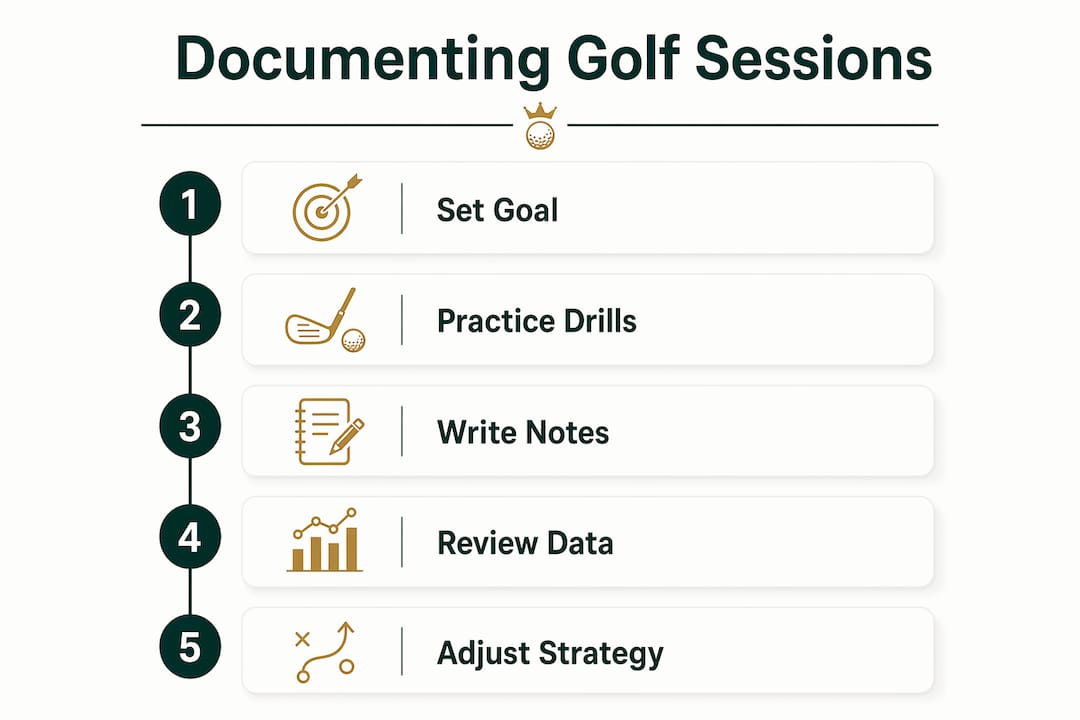
Here is what consistent documentation looks like in practice:
- Session goal: "Reduce three-putt frequency by focusing on lag putting from 30 feet."
- Outcome record: "Hit 20 lag putts. Finished within 3 feet on 14. Three-putted twice in simulated play."
- Trend note: "Improvement from last week's 10 out of 20. Pace control is better; line is still inconsistent on left-to-right breaks."
- Next session target: "Add 10 minutes of left-to-right lag putting before full session."
Each entry builds on the last. Over four weeks, you have a clear narrative of whether your practice is working. Without those notes, you have a vague sense that putting "feels better," which is not accountability. It is optimism.
Pro Tip: Set a specific, measurable target at the start of every session before you hit a single ball. Write it down. That single habit makes every note you take afterward more meaningful.
Why does timing matter when you document sessions?
The timing of documentation directly affects its accuracy. Notes written hours after a session are not records. They are reconstructions. Post-event documentation loses the rationale behind decisions and weakens accountability because the writer fills memory gaps with assumptions rather than facts.
Concurrent documentation, meaning notes taken during or immediately after each drill or segment, solves this problem. Concurrent documentation externalizes memory so you can focus fully during the session rather than trying to hold every detail in your head. The cognitive load of remembering what happened actually competes with the focus required to practice well. Writing it down frees that mental space.
The practical challenge is balance. You cannot stop mid-swing to type notes. The solution is a hybrid approach:
- Use a structured template with pre-filled categories so you only fill in numbers or short phrases.
- Record key metrics immediately after each drill block, not after the full session.
- Keep a voice memo app open for quick observations that you transcribe at the end.
- Limit notes to three to five data points per drill: goal, reps, success rate, key observation, and next adjustment.
Structured templates during sessions reduce cognitive load and improve note quality without breaking your focus. The template does the thinking. You fill in the facts.
Pro Tip: Set a two-minute timer after each drill block. Use those two minutes to write your notes before moving to the next activity. This habit prevents the memory drift that makes post-session notes unreliable.
How do digital tools and automation change session documentation?
Manual note-taking works, but it introduces friction. Friction reduces compliance. Golfers who find documentation burdensome skip it, and skipping it breaks the accountability chain. Automation removes that friction by capturing data without requiring deliberate effort after every shot.
Automated documentation workflows reduce the time required for performance verification by 40%. That efficiency gain is not trivial. It means the time you previously spent reviewing and organizing notes can shift to analyzing trends and adjusting your practice plan.
Golf simulators generate shot data automatically: carry distance, club speed, ball speed, launch angle, spin rate, and shot shape. The accountability benefit comes from logging that data across sessions and comparing it over time. A single session's numbers mean little. Twelve sessions of numbers reveal whether your driver carry is trending up, whether your wedge dispersion is tightening, and whether your practice is actually producing the results you want.
Sim2coursecaddie connects directly to this workflow. The app imports shot data from any golf simulator, logs it automatically, and displays trends in a visual format that makes accountability concrete. You can see whether your seven-iron carry has increased over the past month or whether your miss pattern has shifted. That visibility is what multi-session shot tracking delivers that manual notes alone cannot.
The benefits of automated documentation include:
- Fewer data entry errors because the system captures numbers directly from the simulator.
- Consistent structure across every session, making trend comparison reliable.
- Faster review because data is already organized and visualized.
- Easier identification of plateaus or regressions that would be invisible in scattered manual notes.
Pro Tip: Use a digital dashboard to review your last four sessions before each new practice. Seeing the trend line before you start shapes your goals for that session in a way that reviewing a single session's notes never will.
What are the most common documentation mistakes golfers make?
Most golfers who try to document sessions quit within two weeks. The reason is almost never lack of motivation. It is poor documentation habits that make the process feel useless or disruptive.
The most damaging mistakes follow a predictable pattern:
- Writing vague notes. "Worked on driver" tells you nothing. "Hit 40 drivers, 28 in the fairway zone, 12 left misses, average carry 245 yards" tells you everything.
- Delaying documentation. Waiting until the next day to write notes produces reconstructed records that reflect how you felt about the session rather than what actually happened.
- Over-documenting during drills. Stopping every three shots to write notes breaks your rhythm and defeats the purpose of deliberate practice.
- Recording outcomes but not rationale. Writing "missed left" is less useful than writing "missed left because I was trying to draw the ball and overrotated." The rationale is what drives the next adjustment.
- Using no template. Starting from a blank page every session wastes time and produces inconsistent records that are hard to compare.
The fix for each mistake is structural, not motivational. Use a lightweight template with five fixed fields. Schedule a two-minute documentation window after each drill. Record your reasoning, not just your results. Treat documentation as a system output, not an afterthought. Failing to maintain accurate documentation dramatically weakens your ability to enforce self-accountability and track real progress.
Pro Tip: Keep your template on your phone's notes app with the five fields already typed out. Filling in blanks takes 90 seconds. Building a new format from scratch takes five minutes and usually gets skipped.
How does tracking documented trends directly drive improvement?
Single session notes are useful. Accumulated session trends are transformative. The difference between a golfer who documents occasionally and one who documents consistently is the ability to see patterns that no individual session reveals.
Research from clinical practice shows that tracking documented outcomes across sessions improves detection of performance decline from 2.5% to over 80%. Applied to golf, this means that a golfer reviewing four weeks of session notes will catch a developing problem, such as a gradual increase in pull frequency or a drop in wedge accuracy, long before it shows up as a bad scorecard. Without those notes, the decline is invisible until it becomes a crisis.
Connecting session notes to goals creates a feedback loop that self-corrects. When you see that your three-putt rate has not improved despite three weeks of putting practice, the documentation forces a question: is the practice method wrong, or is the goal unrealistic? That question leads to an adjustment. Without the trend data, you just keep practicing the same way and hoping for different results.
Tracking session trends over time also reveals which practice methods actually work for your game, not which ones feel productive. Feeling productive and being productive are different things. Documentation tells you which is which.
Weekly session comparisons add another layer of accountability by creating a regular review rhythm. Reviewing last week's notes before this week's session takes three minutes and makes every practice decision more deliberate.
Key Takeaways
Documenting practice sessions is the single most effective habit for converting golf practice into measurable, verifiable improvement over time.
| Point | Details |
|---|---|
| Documentation creates accountability | Written records replace memory with objective evidence, making progress or stagnation visible. |
| Timing determines accuracy | Notes taken during or immediately after drills are far more reliable than post-session reconstructions. |
| Automation reduces friction | Digital tools that log shot data automatically remove the burden that causes most golfers to quit documenting. |
| Trends outperform snapshots | Accumulated session data detects performance declines and confirms real improvement in ways single sessions cannot. |
| Rationale matters as much as outcomes | Recording why you made each practice decision preserves context and prevents the bias that undermines accountability. |
What I learned after finally committing to session notes
I resisted documenting my practice sessions for years. My reasoning was that I was at the range to hit balls, not to write. What I discovered after committing to consistent notes was that I had been repeating the same mistakes for two full seasons without knowing it. My pull frequency with the five-iron was not a recent problem. It was a documented pattern I had never noticed because I had no documentation.
The shift that surprised me most was not the data itself. It was how the act of writing changed my focus during practice. Knowing I had to record a result made me more deliberate about each drill. I stopped hitting balls on autopilot. The accountability was not just in the review. It was in the moment of practice itself.
The one mistake I see serious golfers make is treating documentation as a chore separate from improvement. It is not separate. It is the mechanism. Without it, you are practicing in the dark and calling it training.
— Jeff
Sim2coursecaddie makes session documentation automatic
Serious golfers know that consistent documentation is the foundation of real improvement. The challenge is making it sustainable without turning every practice session into a data entry exercise.

Sim2coursecaddie solves that problem by importing shot data directly from your golf simulator and logging it automatically across sessions. The app visualizes your trends in a 3D driving range format, so you can see exactly where your game is improving and where it is stalling. AI-driven club recommendations connect your session data to real course conditions, making your practice directly relevant to your on-course performance. Sim2coursecaddie is available free, with no hardware requirements and no subscription fees. Start tracking your sessions and see what your data actually says about your game.
FAQ
Why does documenting sessions improve accountability?
Documentation replaces memory with objective records, making it impossible to rationalize away stagnation or decline. When your notes show the same miss pattern for four consecutive sessions, the evidence is clear and the accountability is real.
How soon after a session should I write my notes?
Write notes immediately after each drill block, not at the end of the full session. Post-event documentation loses context and accuracy as memory reconstructs rather than recalls what happened.
What should I include in a golf session note?
Record your session goal, the number of reps, your success rate, one key observation, and your reasoning behind any adjustment you made. Five fields per drill block is enough to build meaningful trend data over time.
How does automated documentation help golfers?
Automated tools capture shot data directly from simulators, removing the manual effort that causes most golfers to quit documenting. Automated workflows reduce performance verification time by 40%, freeing you to focus on analysis rather than data entry.
How many sessions does it take to see useful trends?
Four to six documented sessions with consistent structure produce enough data to identify a meaningful pattern. The key is using the same template and the same metrics each time so the comparisons are valid.