
Short-sided means you missed the green on the same side as the pin, leaving almost no green between your ball and the hole. You have no runway. The shot you face next is a high-spin flop or an awkward chip with almost zero margin for error. The fix starts before the shot: use your dispersion data and the 1:1 ratio to decide whether the pin is worth attacking or whether the fat side is the smarter target. Strategy experts like Scott Fawcett have built entire frameworks around this single idea. Sim2coursecaddie makes it measurable across every session.
Stat: A 12-handicap golfer is roughly three times less likely to get up-and-down from a short-sided position compared to a standard miss.
Table of Contents
- What does short sided mean on the course and in your data?
- Why short-siding raises your scoring risk
- A compact decision rule: the 1:1 ratio and when to aim fat
- How to use simulator analytics to spot and fix short-siding
- Simulator drills and a tracking plan to reduce short-sided misses
- Common confusions: short-sided vs. shortsighted and other myths
- Key Takeaways
- Why data beats bravado on approach shots
- Sim2coursecaddie puts the short-side framework in your pocket
- Useful sources and further reading
What does short sided mean on the course and in your data?
On the course, the picture is easy to read once you know what to look for. The pin is tucked near the fringe, a bunker, a slope, or water. If you miss on that same side, you land in a narrow strip of grass with almost nowhere to land the ball softly enough to stop it near the hole. That narrow strip is the problem. Short-siding yourself is both a spatial problem and an execution problem: the geometry punishes you before you even take the club back.
In your simulator analytics, the pattern shows up clearly:
- A cluster of misses plotted on the same side as the pin location you entered
- Ball-to-edge distance that is shorter than pin-to-edge distance on that side
- A skewed dispersion plot where the miss cloud overlaps the tucked-pin zone
- Repeated sessions where your short-side count stays above one or two per round
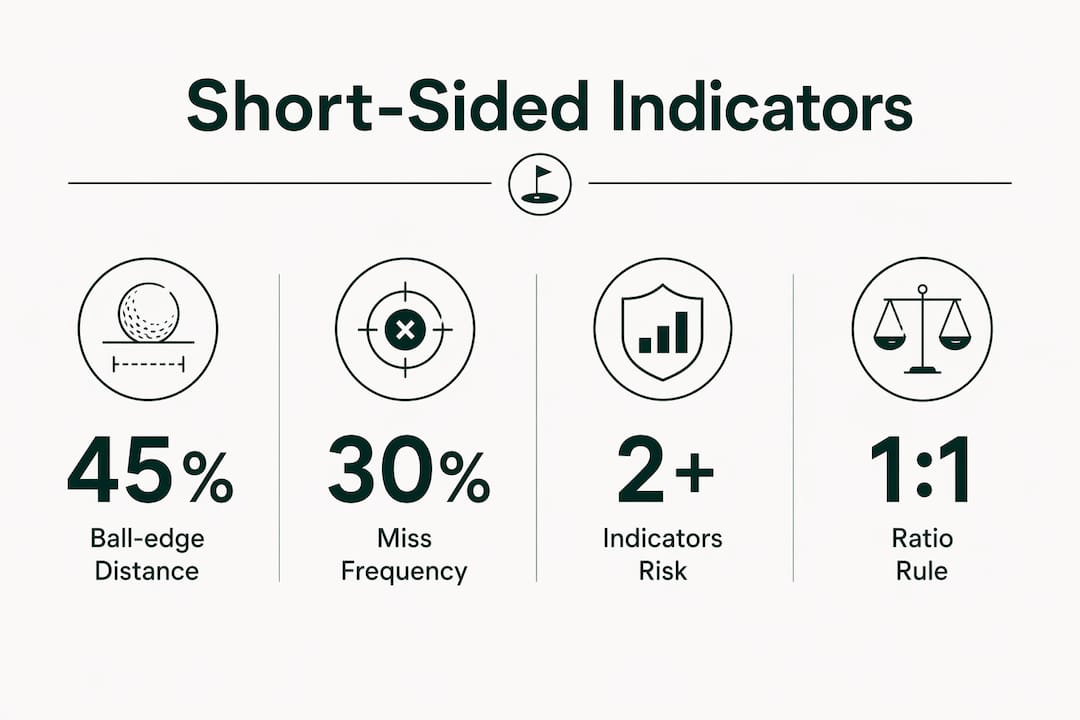
Short-sided miss indicators in simulator data
| Indicator | What to look for | Risk level |
|---|---|---|
| Ball-edge distance | Shorter than pin-edge distance on same side | High |
| Dispersion cluster | Overlaps tucked-pin zone | High |
| Short-side count | More than 2 per simulated round | Moderate–High |
| Skew direction | Misses lean toward pin side | Moderate |
Flag any session where two or more of these indicators appear together. That session deserves a dedicated review before your next practice block.
Why short-siding raises your scoring risk
The scoring math is brutal. When you short-side yourself, the shot you face requires landing the ball in a tiny window, usually with enough spin to stop it quickly. Most amateurs cannot execute that shot reliably. Aiming at the pin often increases the likelihood of a bogey or worse because it raises the chance of bringing the short side into play rather than increasing real birdie probability.

The fat side changes the equation entirely. A miss to the fat side leaves you with more green to work with, a lower-trajectory chip, and a realistic par putt. The up-and-down percentage climbs, and the double-bogey risk drops.
Key scoring consequences of short-siding:
- Forces high, spin-dependent shots that most amateurs execute poorly under pressure
- Reduces up-and-down probability: a 12-handicap is roughly three times less likely to get up-and-down from a short-sided position
- Increases double-bogey exposure when the recovery shot also misses
- Wastes any birdie opportunity the approach might have created
Pro Tip: If you do end up short-sided, play the next shot to land beyond the pin rather than trying to stop it short. Landing past the pin gives you a realistic par putt; trying to stop it short usually means another difficult chip.
A compact decision rule: the 1:1 ratio and when to aim fat
The 1:1 ratio converts an instinct into a repeatable rule. Compare two distances: how far your ball would be from the green edge on the miss side, versus how far the pin is from that same edge. If your ball would be closer to the edge than the pin is, you are in short-side territory. If the pin is closer to the edge than your likely miss, the situation is manageable.
A worked example makes this concrete. Say you have a 140-yard approach. The pin is 8 feet from the right edge. Your 75th-percentile miss to the right lands 5 feet off the green. Ball-to-edge (5 feet) is less than pin-to-edge (8 feet), so a right miss puts you short-sided. Aim left toward the fat side instead.
Before every approach, run this four-step check:
- Measure pin-edge distance. How far is the pin from the nearest dangerous edge?
- Check your dispersion. What does your median and 75th-percentile miss look like for this club and distance?
- Apply the ratio. If your likely miss lands closer to the edge than the pin sits, aim away from that side.
- Select your aim point and club. Commit to the fat side or add a club to move your dispersion away from the short-side zone.
Note: Broadie-inspired Strokes Gained metrics measure the penalty from missed greens by factoring both ball distance off the green and pin distance to the edge — the exact two numbers the 1:1 ratio uses.
How to use simulator analytics to spot and fix short-siding
Sim2coursecaddie turns this framework into a logged, trackable workflow. Here is the step-by-step process:
Import your session, then map green-edge locations for each hole you practiced. Overlay the pin positions you used. Tag each miss by side: short-side, fat-side, or on-green. Run the dispersion and edge-distance reports to see where your miss cloud falls relative to each pin location. Sim2coursecaddie supports multi-session trend tracking so you can watch short-side frequency drop across weeks, not just single sessions.
Key metrics to log per session
| Metric | Why it matters | Suggested threshold |
|---|---|---|
| Median dispersion (yards) | Sets baseline miss distance | Log per club |
| 75th-percentile carry | Worst-case miss distance | Compare to pin-edge |
| Pin-edge distance (feet) | Inputs the 1:1 ratio | Log per hole |
| Ball-edge distance (feet) | Completes the 1:1 check | Log per shot |
| Short-side count | Tracks frequency | Flag if > 2 per session |
Set a filter in your dashboard for sessions where short-side count exceeds two. Those sessions surface automatically for review, so you are not hunting through raw data manually. Golf data analysis best practices recommend reviewing flagged sessions within 48 hours while the feel of each shot is still fresh.
Simulator drills and a tracking plan to reduce short-sided misses
Three drills, run consistently, move the needle faster than any single swing change.
- Fat-side aiming drill. Pick a target 10–15 feet to the fat side of the pin. Hit 10 approach shots per club. Log how many land in the fat-side zone. Repeat until 70% or more land there consistently.
- Edge-awareness drill. Set a landing zone that requires your ball to finish at least 5 feet beyond the pin. This trains carry control and removes the instinct to aim short.
- Short-side recovery drill. From progressively shorter distances (20, 15, 10 yards), practice the recovery shot from a short-sided lie. Log up-and-down outcomes to build a realistic success rate you can reference on the course.
Session tracking template
| Field | What to log |
|---|---|
| Target aim point | Pin or fat side (note distance from edge) |
| Club used | Iron, hybrid, wedge |
| Pin position | Edge distance in feet |
| Ball-edge distance | Feet from edge on miss side |
| Result | On green / short-side miss / fat-side miss |
| Up-and-down outcome | Made / missed / no attempt |
Review weekly rolling averages split by club and by pin location. A realistic measurable goal: reduce short-sided misses by 30% across eight practice sessions, and raise your up-and-down rate from short-side positions by 10 percentage points. Tracking misses across sessions is what separates golfers who improve from those who just practice.
Common confusions: short-sided vs. shortsighted and other myths
A few misunderstandings come up constantly, and they cost golfers strokes.
- "Short-sided" and "shortsighted" are not the same word. Short-sided is a golf spatial term describing where your ball landed relative to the pin. Shortsighted means either poor vision or a lack of foresight. They sound similar but describe completely different things.
- Aiming at the pin does not improve your birdie odds. For most amateurs, it raises short-side risk and bogey probability. The fat side is the higher-percentage play on tucked pins.
- A slightly off-center pin is not automatically dangerous. Use the 1:1 ratio and actual edge distances to judge. A pin that looks tucked may still have enough room on both sides to make the miss manageable.
Key Takeaways
Avoiding short-sided misses starts with one rule: compare your likely ball-to-edge distance against the pin-to-edge distance before every approach, and aim to the fat side when the ratio flags high risk.
| Point | Details |
|---|---|
| Core definition | Short-sided means missing the green on the same side as the pin, leaving almost no green to work with. |
| The 1:1 ratio | If your likely miss lands closer to the edge than the pin sits, aim to the fat side instead. |
| Scoring cost | A 12-handicap is roughly three times less likely to get up-and-down from a short-sided position. |
| Track what matters | Log pin-edge distance, ball-edge distance, and short-side count per session to measure real progress. |
| Sim2coursecaddie | Use the free analytics tier to map dispersion, tag short-side misses, and track frequency across sessions. |
Why data beats bravado on approach shots
Most golfers know, somewhere in the back of their mind, that aiming straight at a tucked pin is a gamble. They do it anyway because the birdie feels closer than the bogey feels far. That gap between knowing and doing is exactly where data closes the argument.
When you can pull up a dispersion plot and see, in plain numbers, that your 7-iron misses right 40% of the time and the pin is 6 feet from the right edge, the decision stops being a debate. The fat side wins. Not because someone told you to play safe, but because your own numbers say the pin is a losing target on that hole with that club.
Multi-session analytics also reveal something single-round scorecards hide: patterns. A golfer who short-sides twice per round might not notice it in the moment, but eight sessions of logged data make it undeniable. That visibility is what actually changes behavior, and changed behavior is what lowers scores.
Sim2coursecaddie puts the short-side framework in your pocket
Every workflow described in this article, from logging pin-edge distances to running dispersion reports and flagging short-side sessions, is built into Sim2coursecaddie's free analytics tier. Import shot data from any simulator or launch monitor, visualize your miss clusters in 3D, and let the app surface the sessions where short-siding is costing you strokes.

The Pro tier adds live GPS caddie and AI-driven club recommendations tied to real-time course conditions, so the 1:1 ratio check happens automatically on the course, not just in post-session review. For golfers serious about course management strategy, that combination of practice analytics and on-course guidance is where the scoring gains compound.
Start with one tagged session using the tracking template above. Try the free analytics and run your first short-side frequency report today.
Useful sources and further reading
The claims in this article draw from the following sources. Use them to verify specific figures or go deeper on any concept.
| Source | What it covers |
|---|---|
| Practical Golf: Fat Side Wins | Definition of short-sided, fat-side strategy, and recovery tip |
| Golf.com: What short-sided means | Coaching explanation of aim selection causing short-side positions |
| Golf Digest: The 1:1 ratio | Origin and application of the 1:1 ratio rule; Broadie metric context |
| Sigette Golf: What is short-sided? | Amateur up-and-down penalty statistic for short-sided positions |
| Merriam-Webster: Shortsighted | Dictionary definition distinguishing shortsighted from short-sided |
| Cambridge Dictionary: Shortsighted | Additional language reference for the shortsighted vs. short-sided distinction |
For applied workflows, the Sim2coursecaddie blog covers how practice data becomes course strategy and how personal shot data informs club choice, both directly relevant to the decision framework and drills described above.