
Course management strategy is the process of making deliberate shot decisions that balance risk and reward to maximize scoring potential on every hole. Most golfers focus on swing mechanics, but poor decision-making costs 3–5 strokes per round on average. That gap is wider than most swing flaws. The good news is that you can close it without hitting a single range ball. This guide breaks down what is course management strategy explained in full, covering the core principles, practical techniques, and mental habits that separate consistent players from those stuck at the same handicap year after year.
What is course management strategy in golf?
Course management strategy is defined as the structured approach to planning and executing shots based on probability, positioning, and risk evaluation rather than raw ball-striking ability. The industry distinguishes between two related but separate concepts. Course strategy refers to pre-round planning: studying the scorecard, reviewing GPS maps, and identifying where trouble lives on each hole. Course management refers to real-time adaptation during play, adjusting that plan based on wind, lie, and pin position as conditions change.
Both concepts work together. A golfer who plans well but panics under pressure loses the benefit of preparation. A golfer who adapts well but starts with no plan wastes mental energy on decisions that could have been made in the parking lot. The DECADE system, developed by Scott Fawcett, formalizes this process by using strokes-gained data to assign shot values and guide target selection. It is one of the most widely referenced frameworks in modern course management education.
The core principle behind every effective course management technique is probability. A shot with less than 50% success probability is almost always the wrong choice, regardless of how good it looks in your head. That single rule eliminates most of the costly mistakes amateurs make each round.
What are the core components of course management strategy?
Effective course management rests on five interconnected principles. Each one addresses a specific decision point during a round.
-
Accurate club distances. Club selection requires average carry distances, not your best-ever distances. Most golfers overestimate by 10–15 yards, which sends approach shots into trouble short of the green. Tracking realistic distances through personal shot data is the foundation of every other decision.
-
Center-green targeting. Aiming for the center of the green instead of attacking tucked pins reduces short-siding risk and creates more two-putt opportunities. Pros attack pins because their misses are small. Amateurs attack pins and miss by 20 yards.
-
Risk-versus-reward evaluation. Before any shot, ask "Should I make this shot?" not "Can I make this shot?" The DECADE framework uses this exact mental shift to filter out hero shots with low success probability.
-
Pre-round preparation. Reviewing the scorecard and GPS maps before the round converts blind shots into calculated decisions. Five minutes of map review can change how you play three or four holes.
-
Mental discipline. Effective course management requires patience and the ability to stick with the plan after a bad hole. Emotional decisions after bogeys are where rounds fall apart.
Pro Tip: Before your next round, write down the one club you will never hit from trouble. Committing to that rule in advance removes the temptation to go for it when adrenaline takes over.
How does effective course management reduce scores without changing your swing?
Golfers can trim 5–7 strokes from their handicap by improving on-course decision-making alone. That is a meaningful number. For context, most golfers spend months working on swing changes to gain one or two shots. Better decisions cost nothing and work immediately.
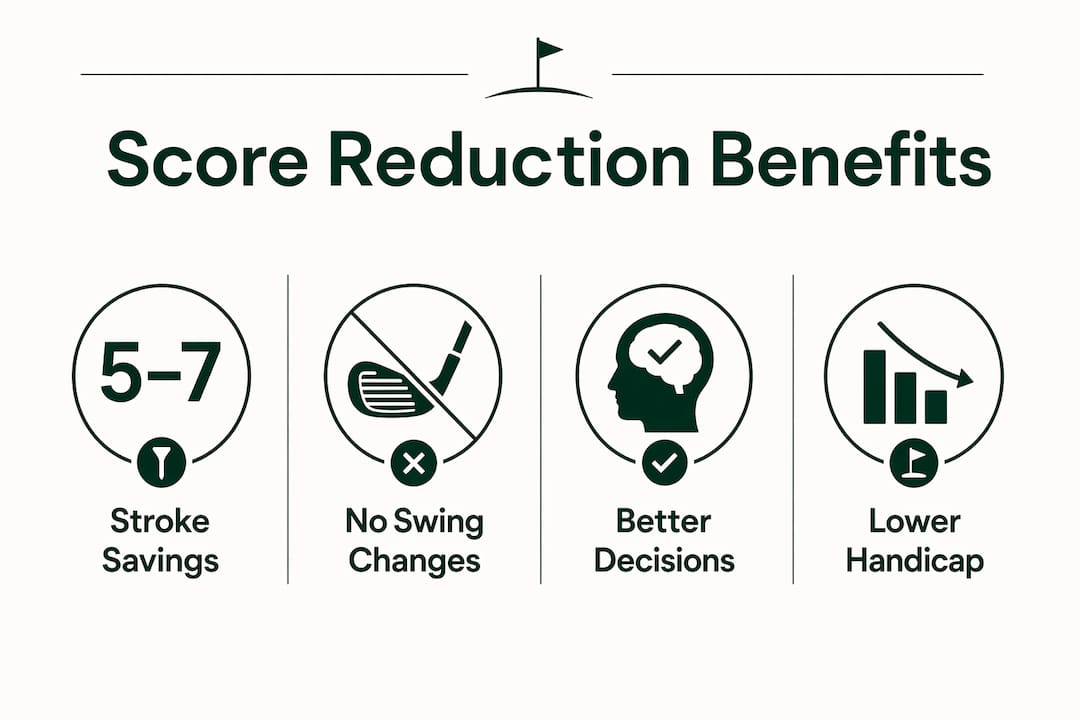
The mechanism is straightforward. Every time you overestimate your carry distance and come up short in a bunker, that is a decision error, not a swing error. Every time you chase a hero shot from behind a tree and make double bogey, that is a decision error. Decision-making errors outweigh swing flaws in scoring impact for the vast majority of amateur golfers.
Avoiding trouble is not the same as playing scared. The goal is positioning. A tee shot that lands in the fairway 20 yards shorter than your maximum gives you a full approach from a clean lie. That outcome beats a driver into the rough every time, even if the rough shot is technically closer to the pin. Consistent, lower-risk shots compound across 18 holes into a meaningfully lower score.

Blow-up holes are the biggest score killers for most golfers. A triple bogey on one hole erases three pars. Strategic play reduces the frequency of those holes by keeping you out of positions where recovery requires a miracle. Fewer blow-ups means a steadier scorecard, even when ball-striking is average.
What practical techniques improve course management during play?
Turning strategy into habit requires a repeatable process for each hole. These steps work for golfers at every level.
-
Plan the hole backward. Visualize your preferred approach location first, then select the tee shot that puts you there. On a dogleg par 4, the best approach angle often requires a shorter tee shot with a mid-iron rather than a driver into the corner.
-
Take one more club than you think. Most amateurs come up short on approach shots because they use best-case distances. Taking an extra club and swinging at 80% produces more consistent contact and more greens hit.
-
Avoid short-siding yourself. Missing on the same side as a tucked pin leaves an almost impossible chip. Miss to the fat side of the green and accept the longer putt.
-
Accept the good bogey. From trouble, the priority is getting back to the fairway in one shot. A bogey from a clean lie beats a double from a risky recovery attempt every time.
-
Log your club distances. Shot-by-shot data logging over multiple rounds reveals your true averages. Those numbers replace guesswork with facts.
-
Use a pre-shot routine. Committing fully to a target before each shot reduces in-swing doubt. Pick a specific spot, not a general direction, and trust the decision.
-
Adapt to conditions. Course management involves real-time adjustments for wind, wet lies, and fatigue. A plan made on the first tee should flex by the back nine.
Pro Tip: After each round, identify the two decisions that cost you the most strokes. Write them down. Patterns emerge quickly, and awareness alone changes behavior.
How do coaches and advanced players build course management into training?
Coaches who work on course management treat it as a skill, not a personality trait. The process starts with data. Launch monitors and shot-tracking tools give golfers accurate carry distances for every club in the bag. That data removes the optimism bias that causes most club-selection errors.
Data visualization in golf performance takes raw numbers and turns them into patterns. A golfer who sees a scatter plot of their 7-iron shots understands their real dispersion. That picture is more persuasive than any verbal instruction. Knowing that 80% of your 7-iron shots land within a 30-yard-wide window changes how you aim.
Pre-round preparation is a trainable habit. Coaches assign golfers to review course maps before competitive rounds and write down a plan for each hole. Reviewing course maps before rounds reduces blind shots and builds confidence in target selection. Over time, this becomes automatic.
Playing to your strengths is a core principle in advanced course management. Knowing which clubs you hit most consistently, and building your hole strategy around those clubs, reduces reliance on low-percentage shots. A golfer who hits a 5-iron reliably but struggles with a 3-wood should design their game around the 5-iron, not force the 3-wood because the yardage calls for it.
Mental training rounds out the picture. Course management is as much mental as physical, requiring patience and the ability to stay committed through bad stretches. Coaches use post-round debriefs, decision journals, and pressure simulations to build that discipline. The DECADE system formalizes this by giving golfers a repeatable decision framework they can apply under pressure without overthinking.
Key Takeaways
Effective course management reduces scores by replacing emotional decisions with probability-based choices, and golfers who apply it consistently can cut 5–7 strokes without changing their swing mechanics.
| Point | Details |
|---|---|
| Use average distances | Base club selection on realistic carry averages, not your best-ever shots. |
| Plan holes backward | Identify your ideal approach spot first, then choose the tee shot that gets you there. |
| Target center green | Aiming away from tucked pins reduces short-siding and creates more two-putt chances. |
| Apply the 50% rule | Avoid any shot with less than a 50% success probability. Lay up or play safe instead. |
| Log and review data | Tracking shot data over multiple rounds reveals true distances and exposes decision patterns. |
Why strategy beats swing work every time
I have watched golfers spend entire winters rebuilding their swing, only to shoot the same scores the following spring. The swing looks better. The ball flight is cleaner. But the decisions are identical, and the scorecard reflects it.
Course management is the great equalizer. A 15-handicapper who plays smart golf beats a 10-handicapper who plays recklessly more often than people expect. The difference is not talent. It is discipline. Choosing the right target, accepting the bogey, and resisting the urge to go for broke on a 30% shot. These are learnable skills, and they pay off faster than any technical change.
The mental trap I see most often is the "I almost made it" justification. A golfer goes for a hero shot, misses by a foot, and calls it a good decision because the outcome was close. That reasoning is backwards. The decision was poor because the probability was low. The near-miss was luck, not skill. Separating outcomes from decision quality is the hardest mental shift in golf, and the most valuable one.
My honest advice is to spend one round playing purely for position. No hero shots. No pin attacks from 180 yards. Just fairways, center greens, and smart recoveries. Most golfers who try this are surprised by how much lower they score, even when they feel like they are leaving shots on the table.
— Jeff
How Sim2coursecaddie supports your course management
Sim2coursecaddie gives golfers the data foundation that makes course management decisions reliable. The app imports shot data from any golf simulator, calculates your real carry distances across every club, and delivers AI-driven club recommendations based on actual course conditions.

Knowing your true numbers removes the guesswork that causes most strategic errors. Sim2coursecaddie also visualizes your shot patterns in a 3D driving range view, so you can see your actual dispersion before you ever reach the first tee. That information directly supports pre-round planning and target selection. The platform is available for free, with no hardware requirements. Visit Sim2coursecaddie to connect your simulator data to smarter on-course decisions.
FAQ
What is course management strategy in golf?
Course management strategy is the process of making shot decisions based on probability and positioning rather than raw power or optimism. It combines pre-round planning with real-time adjustments to minimize risk and maximize scoring potential.
How many strokes can better course management save?
Golfers can save 5–7 strokes per round through improved decision-making alone, without any changes to swing mechanics.
What is the DECADE system in golf?
DECADE is a course management framework developed by Scott Fawcett that uses strokes-gained data to guide target selection and shot decisions. It formalizes the probability-based thinking that separates strategic players from reactive ones.
Why should I aim for the center of the green?
Center-green targeting reduces the risk of short-siding yourself next to a tucked pin and creates more two-putt opportunities. Attacking pins only makes sense when your miss distance is small enough to stay on the green.
How does pre-round preparation improve course management?
Reviewing the scorecard and course maps before a round converts blind shots into calculated decisions. Even five minutes of preparation reduces in-round uncertainty and improves target selection across all 18 holes.