
Tracking multiple clubs simultaneously is the most direct method for exposing structural weaknesses in your golf game. A single club's data tells you almost nothing about your overall performance. Analyzing club performance across your entire bag reveals patterns that isolated sessions never surface. Metrics like shot dispersion and efficiency vary systematically by club type and correlate directly with scoring success. The industry term for this approach is multi-club performance analysis, and it is the standard used by serious players who want to move beyond guesswork and into targeted improvement.
Why tracking multiple clubs reveals weaknesses in your game
A weakness in golf is rarely a single bad shot. Research confirms that a true weakness is a structural failure that shows up repeatedly across clubs, yardage zones, and shot types. When you only review one club at a time, you miss the repeating pattern entirely. You might blame your 7-iron for a rough round, when the real problem is a swing fault that also affects your 6-iron and your hybrid.
The importance of tracking clubs across your full bag comes down to context. One club's dispersion chart looks like noise. Three clubs' dispersion charts showing the same left-miss tendency look like a diagnosis. That shift from noise to signal is exactly what multi-club tracking delivers.
What performance metrics reveal when tracking multiple clubs
The right metrics make the difference between useful data and a pile of numbers. When analyzing club performance, three indicators matter most.
- Shot dispersion: How far your shots scatter from the intended target line. Dispersion measured across multiple clubs shows whether your miss pattern is club-specific or a swing-wide fault. A tight dispersion on short irons but wide dispersion on mid-irons points to a transition issue, not a grip problem.
- Shot efficiency: The ratio of actual distance to expected distance for each club. Efficiency metrics are stronger predictors of consistent results than raw distance totals. A golfer who consistently achieves 95% of expected distance across all clubs is more reliable than one who occasionally maxes out a single club.
- Expected outcomes: The probability of a given shot reaching its intended zone. Tracking expected outcomes by club reveals which parts of your bag underperform relative to your scoring goals.
Measuring these metrics for each club separately, rather than as aggregate totals, is what separates useful analysis from surface-level stats. An aggregate average hides the club that is dragging your numbers down.
Pro Tip: Start with dispersion data for your 5 most frequently used clubs. If two or more show the same miss direction, you have a systemic fault worth addressing before touching your swing mechanics.

How fragmented tracking creates blind spots
Golfers who track clubs in isolation, or use separate apps for different sessions, create a silo effect that hides the very patterns they need to see. The silo effect is a documented problem in performance analysis: when data lives in separate places, no single view shows the whole picture.
"Context switching between fragmented data sources leads to focus on isolated signals rather than comprehensive performance patterns, and that is the key barrier to athletic improvement." — Performance research on fragmented training data
The practical cost of fragmentation shows up in three specific ways:
- Delayed correction: Manual data reconciliation creates latency between when a fault appears and when you act on it. Stale data means you are correcting last week's swing, not today's.
- Lost context: A shot that looks like an outlier in one session looks like a trend when compared against six sessions of data from the same club. Fragmented systems destroy that comparison.
- Reactive practice: Without a unified view, golfers default to working on whatever felt bad in the last round. That is reactive, not analytical. Fragmented data prevents the root cause identification that drives real improvement.
The fix is not more data. The fix is unified data. All clubs, all sessions, one database.
Identifying structural weaknesses through multi-club patterns
Pattern recognition across multiple clubs is where the real diagnostic work happens. A structural weakness is a fault that repeats across different clubs under similar conditions. Repeated pattern recognition is the method elite athletes use to separate fixable faults from noise.
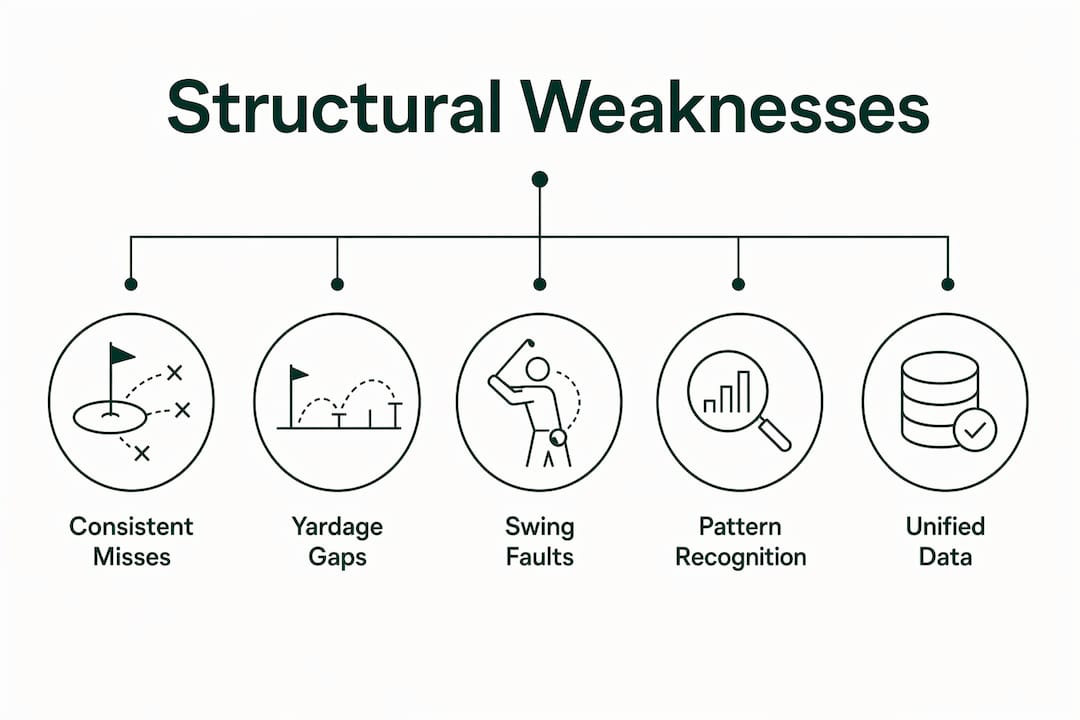
The table below shows how multi-club tracking maps common fault types to their likely root causes.
| Observed pattern | Clubs affected | Likely root cause |
|---|---|---|
| Consistent left miss | 5-iron through 8-iron | Path or face angle fault at impact |
| Distance loss at longer clubs | Driver, 3-wood, 5-wood | Tempo breakdown under load |
| High dispersion at mid-irons only | 5-iron through 7-iron | Transition timing issue |
| Short of target across all clubs | All irons | Ball striking contact, not swing path |
| Yardage gap between clubs | 6-iron and 7-iron | Loft or shaft inconsistency |
This kind of table is only possible when you have data from multiple clubs in one place. A golfer reviewing only their 7-iron data would never spot the yardage gap between the 6 and 7. They would just keep hitting the 7 and wondering why they always come up short.
Yardage gaps are a specific and common structural weakness. They create dead zones on the course where no club in your bag fits the required distance. Identifying them requires club-specific data compared side by side, not reviewed in isolation.
Pro Tip: Map your average carry distance for every club in your bag, then look for gaps larger than 15 yards between consecutive clubs. Those gaps are scoring liabilities on approach shots.
Practical steps to analyze and apply multi-club tracking insights
Applying the impact of multi-club tracking to your practice routine requires a structured approach. The goal is to move from data collection to targeted correction.
- Consolidate all club data into one system. Every session, every club, every shot should feed into a single database. Unified data frameworks shift your practice from reactive correction to planned improvement. Sim2coursecaddie imports shot data from any golf simulator and stores it in one place, so you never lose session context.
- Review dispersion and efficiency weekly, not after every session. Single-session data is noisy. Weekly reviews reveal trends. Look for patterns that appear in at least two consecutive weeks before making swing changes.
- Prioritize club-specific weaknesses over general swing fixes. If your dispersion data shows a problem only with your long irons, work on long irons. Do not rebuild your entire swing based on one club's data.
- Use your bag tracking data to set practice priorities. If you hit your 8-iron 40 times per round and your 4-iron twice, your practice time should reflect that ratio. Tracking usage frequency alongside performance data tells you where to spend your time.
- Test adjustments over a defined period. Make one change, track it for three to four weeks across multiple clubs, and measure whether dispersion or efficiency improves. Avoid stacking multiple changes at once. You will not know which one worked.
The golfer who follows this process builds a feedback loop. Data informs practice. Practice changes data. That cycle is how consistent improvement happens.
Key takeaways
Tracking multiple clubs in a unified system is the only reliable method for separating structural swing faults from isolated bad shots.
| Point | Details |
|---|---|
| Multi-club tracking exposes patterns | Reviewing all clubs together reveals systemic faults that single-club analysis always misses. |
| Dispersion and efficiency are the key metrics | These two indicators predict scoring consistency better than raw distance or shot volume. |
| Fragmented data creates blind spots | Siloed tracking systems hide root causes and delay corrective action by weeks. |
| Yardage gaps are structural weaknesses | Comparing carry distances across consecutive clubs identifies scoring liabilities on approach shots. |
| Unified data enables targeted practice | One database for all clubs shifts practice from reactive to planned and measurable. |
What I've learned from watching golfers ignore their own data
Most golfers I talk to track one or two clubs they feel confident about and ignore the rest. That is exactly backwards. The clubs you feel good about are not the problem. The clubs you avoid are where your scorecard bleeds.
The most common misconception I see is that tracking more clubs means more complexity. The opposite is true. When all your club data lives in one place, the patterns become obvious fast. You stop second-guessing your 6-iron and start seeing that your miss is a mid-iron problem, not a 6-iron problem. That distinction alone saves you weeks of misdirected practice.
I have also seen golfers make the mistake of acting on single-session data. One bad day with the driver does not mean your driver is broken. Three weeks of data showing the same left miss across your irons and driver means something is broken. Patience with data collection is a skill, and most golfers skip it entirely.
The golfers who improve fastest are the ones who treat their shot data the way a coach would. They look for patterns, not excuses. They ask "what does the data show across all my clubs?" before they ask "what felt wrong today?" That shift in question changes everything about how you practice.
— Jeff
How Sim2coursecaddie puts your full bag under the microscope
Sim2coursecaddie was built for golfers who want to see their entire bag's performance in one place, not scattered across sessions and apps.
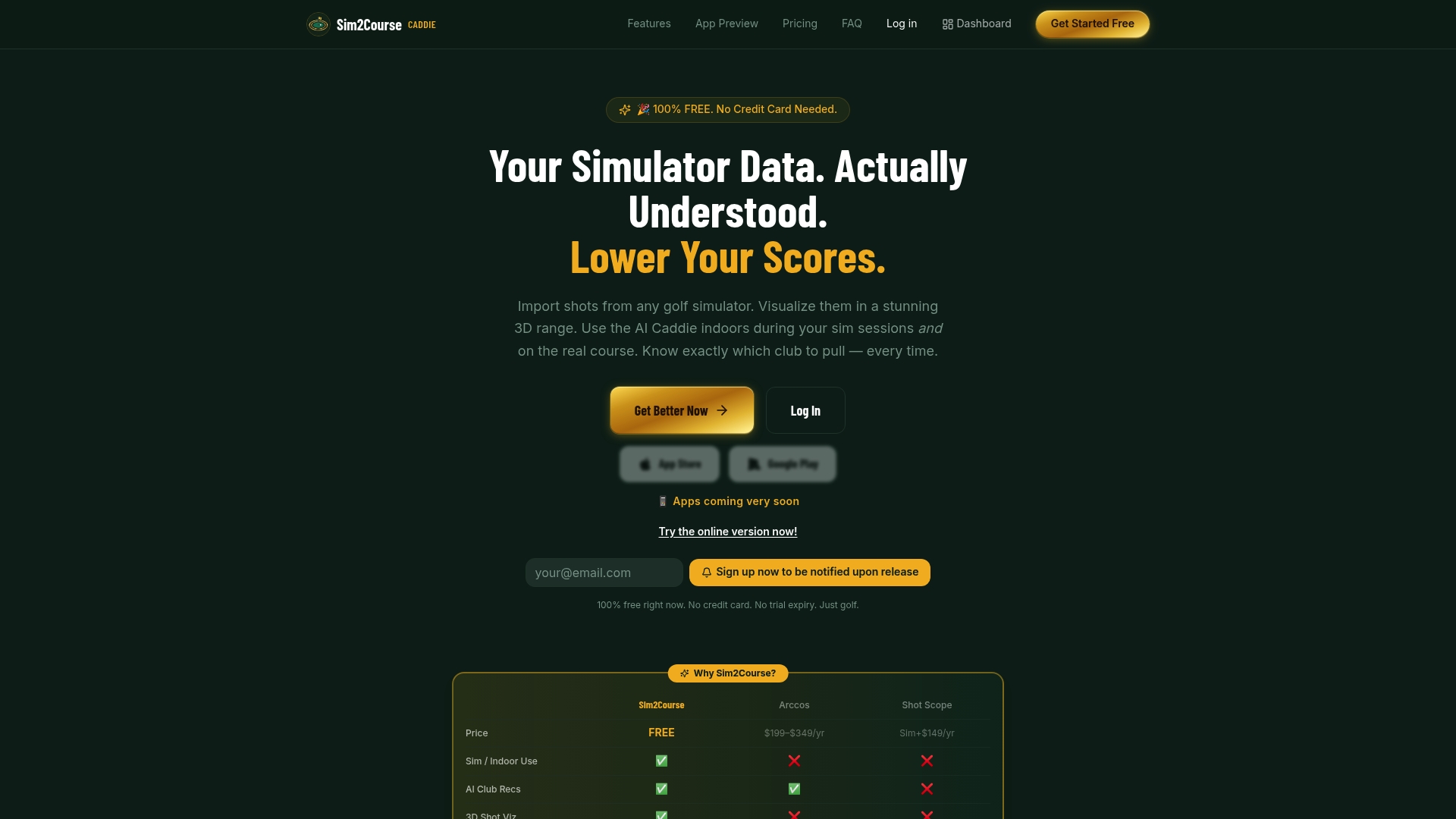
The platform imports shot data from any golf simulator and displays it in a 3D driving range view that makes dispersion patterns immediately visible. The raw data dashboard breaks down efficiency and expected outcomes by club, so you can spot yardage gaps and systemic faults without manual calculations. The My Bag feature tracks every club's performance history in one database, and the AI caddie delivers club recommendations based on your actual shot data, not generic averages. All of this is available for free, with no hardware required.
FAQ
Why does tracking one club at a time miss weaknesses?
Single-club tracking shows isolated performance without the cross-club context needed to identify repeating faults. A weakness that spans multiple clubs is invisible until all club data is reviewed together.
What metrics matter most when analyzing club performance?
Shot dispersion and efficiency are the strongest predictors of consistent scoring. Efficiency metrics outperform raw distance totals as indicators of reliable performance across clubs.
How does fragmented tracking hurt improvement?
Fragmented systems create data latency and context loss, which means you correct faults late and miss patterns that only appear across multiple sessions. Unified data eliminates both problems.
What is a yardage gap and why does it matter?
A yardage gap is a distance zone where no club in your bag reliably lands. It creates approach shot dead zones that cost strokes, and it only becomes visible when you compare carry distances across consecutive clubs.
How often should I review my multi-club tracking data?
Weekly reviews of dispersion and efficiency data give you enough sample size to separate trends from noise. Acting on single-session data leads to unnecessary swing changes.