
Shot consistency is defined as the ability to reproduce the same swing mechanics, contact, and ball flight across repeated attempts. Data analysis of golf performance reveals that most golfers lose strokes not from a lack of power but from a small set of recurring mechanical and tracking failures. Understanding what the common consistency killers data reveals gives you a direct path to lower scores. The good news is that these killers are identifiable, measurable, and fixable when you know where to look.
1. What are the top common consistency killers data reveals in golf?
Data from golf performance tracking consistently points to the same culprits across skill levels. These are not random errors. They are patterns that repeat session after session until a golfer addresses them directly.
The most frequently identified shot consistency killers include:
- Grip pressure variation: Tightening or loosening grip mid-swing changes clubface angle at impact.
- Weight transfer timing: Shifting too early or too late disrupts the kinetic chain and produces thin or fat shots.
- Swing plane inconsistency: Even small deviations from your established plane produce significant dispersion at distance.
- Ball position drift: Moving the ball forward or back in your stance by even an inch changes launch angle and spin rate.
- Pre-shot routine gaps: Skipping or rushing the routine breaks the mental and physical reset that produces repeatable swings.
- Tempo variation: Rushing the downswing is one of the most common causes of off-center contact.
- Setup alignment errors: Open or closed shoulders at address redirect the swing path before the club even moves.
Each of these factors produces what performance analysts call "shot outcome variability," which is the spread between your best and worst shots with the same club. Reducing that spread is the real goal of consistency work.
Pro Tip: Track which of these seven killers appears most often in your session notes. Golfers who identify their top two killers and focus practice on those specific faults improve their shot dispersion faster than those who work on everything at once.

2. How data quality problems undermine golf shot tracking
Reliable data is the foundation of any consistency analysis. When the data itself is flawed, the insights it produces are worse than useless. They point you in the wrong direction.
Inadequate information quality is the primary consistency challenge for 64% of organizations that rely on data systems. In golf performance tracking, this translates directly to manual entry errors, duplicate shot records, and mismatched session timestamps. A golfer reviewing a session summary built on bad data may conclude they have a swing plane problem when the real issue is a data entry error.
Silent pipeline failures are the most dangerous data quality problem because they leave data looking valid while it is actually stale or wrong. For a golfer using a simulator app, this means a session could appear to show improvement when the underlying shot data never updated correctly.
Data duplication and redundancy increase the risk of consistency failures even when they are introduced to improve availability. Every extra copy of a shot record creates a synchronization liability. If two copies of the same swing data disagree, the analysis built on them is unreliable.
| Data quality problem | Effect on golf performance insight |
|---|---|
| Duplicate shot records | Inflates average distances, skews dispersion maps |
| Manual entry errors | Misidentifies swing faults, creates false patterns |
| Stale data from pipeline failures | Shows outdated trends as current performance |
| Time-zone or timestamp mismatches | Scrambles session order, breaks trend analysis |
| Fragmented data across systems | Prevents accurate multi-session comparison |
3. How synchronization and data consistency models affect shot data
Golf performance apps pull data from simulators, wearables, and cloud storage simultaneously. The way these systems handle data consistency directly affects what you see on screen.
Network latency causes delayed synchronization, producing temporary inconsistencies that affect real-time data use. In practical terms, a shot you hit may not appear in your session summary for several seconds, or it may appear with incorrect values if the sync window closes too early. This is not a bug. It is a known trade-off in distributed data systems.
Strong consistency is expensive and often unnecessary, and context drives the selection of consistency models. Golf shot tracking does not require every system to agree on data in real time. A model called eventual consistency, where all systems reach agreement after a short delay, works well for post-session analysis. Strong consistency matters more for real-time club recommendations during play.
Consistency failures stem from physical constraints like clock skew and network partitions more often than from software bugs. Golfers and coaches who understand this interpret data gaps as system behavior rather than missing shots. That distinction prevents false conclusions about performance.
| Consistency model | Best use case | Trade-off for golf tracking |
|---|---|---|
| Strong consistency | Real-time club recommendations | Higher latency, more processing cost |
| Eventual consistency | Post-session shot analysis | Short delay before data is fully accurate |
| Causal consistency | Ordered drill sequences | Moderate complexity, good for session flow |
4. Why a single source of truth matters for your game
Fragmented data is one of the most underrated factors affecting data consistency in golf. When your shot data lives in three different places, none of them agree on what actually happened during your session.
Lack of a single source of truth leads to conflicting data sources and inconsistent reporting, which undermines trust and decision-making. For a golfer, this plays out as contradictory feedback. Your simulator says your average carry with a 7-iron is 165 yards. Your manual notes say 158 yards. Your app shows 171 yards. None of these numbers help you make a good club selection on the course.
Data integrity alone does not ensure data consistency. Consistency requires that all downstream systems agree, which calls for multi-layer reconciliation. Practically, this means your simulator data, your app, and your session notes need to feed into one central record that you trust completely.
The solution is to pick one tracking system and commit to it. Centralizing your shot data in one place removes the noise that makes consistency analysis unreliable.
5. Practical strategies to reduce consistency killers on the course
Identifying consistency killers is only half the work. Reducing them requires a structured practice approach backed by reliable data.
The most effective prevention tactics include:
- Automate your data capture. Manual entry introduces errors. Automated performance tracking removes the human error layer from your session records.
- Document every session. A short note after each practice round about what felt different creates a qualitative record that supports your quantitative data.
- Focus on one fault per session. Golfers who try to fix three things at once rarely fix any of them. Pick the top killer your data shows and work on it exclusively.
- Review multi-session trends, not single sessions. One bad session proves nothing. Multi-session shot tracking reveals the patterns that actually cost you strokes.
- Use visual feedback. Watching your swing data in a 3D format helps you connect what you feel to what the data shows, which accelerates correction.
- Set baseline benchmarks. Before working on a fault, record your current dispersion with each club. This gives you a measurable starting point.
Five recurring data problems, including duplicate records and silent pipeline failures, produce confidently wrong answers rather than obvious errors. The same principle applies to practice. If your tracking system is unreliable, your practice plan is built on a false picture of your game.
Pro Tip: Review your last five sessions together, not individually. Patterns that look like random variation in one session become clear consistency killers when you look at the full picture. Sim2coursecaddie makes this multi-session view easy to access without manual data assembly.
6. How AI-driven analysis surfaces hidden consistency problems
Artificial intelligence changes what is possible in consistency analysis. Manual review of shot data can identify obvious patterns. AI finds the subtle ones that human eyes miss.
Advanced consistency techniques such as idempotency keys and version vectors support complex distributed data synchronization and improve reliability. In a golf app context, these techniques mean that even when your simulator and your phone sync at different times, the AI receives a clean, ordered data set to analyze. The result is more accurate identification of your actual consistency killers.
AI also removes confirmation bias from the analysis. Golfers tend to remember their best shots and attribute bad ones to external factors. An AI system reviewing your improvement opportunities treats every shot equally and surfaces patterns you would not find on your own.
Data visualization turns raw shot numbers into pictures that make consistency problems obvious. Seeing your shot dispersion mapped in 3D is more informative than reading a table of carry distances. The visual format connects the data to the physical reality of your swing.
Key Takeaways
The most effective way to improve shot consistency is to identify your top two data-backed killers, fix your data tracking system, and review multi-session trends rather than single-session results.
| Point | Details |
|---|---|
| Name your killers | Data reveals seven recurring shot killers; identifying your top two accelerates improvement. |
| Fix data quality first | Duplicate records, manual errors, and silent failures produce misleading performance insights. |
| Use one data source | Fragmented tracking systems create conflicting reports that undermine every decision you make. |
| Automate your tracking | Automated capture removes manual entry errors and produces more reliable consistency analysis. |
| Review trends, not sessions | Multi-session data reveals true consistency patterns that single sessions hide. |
What I've learned from watching golfers fight their own data
Golfers are competitive by nature. When they get access to performance data, the instinct is to act on every number immediately. That instinct is the problem.
The golfers I have seen improve fastest are the ones who treat their data like a long-term investment. They do not react to one bad session. They look for the fault that shows up in session three, session seven, and session twelve. That fault is the real consistency killer. The others are noise.
The other thing I have noticed is that data quality problems are invisible until they are not. A golfer will spend six weeks working on their swing plane based on data that was corrupted by duplicate records or a sync failure. When the numbers do not improve, they blame their swing. The data was wrong the whole time.
My honest recommendation is to spend as much time choosing and trusting your tracking system as you spend on your swing mechanics. A reliable data foundation is not a technical detail. It is the difference between practicing the right thing and practicing the wrong thing with great discipline.
— Jeff
Sim2coursecaddie and your consistency data
Sim2coursecaddie is built specifically for golfers who want to use their simulator data to play better on real courses.
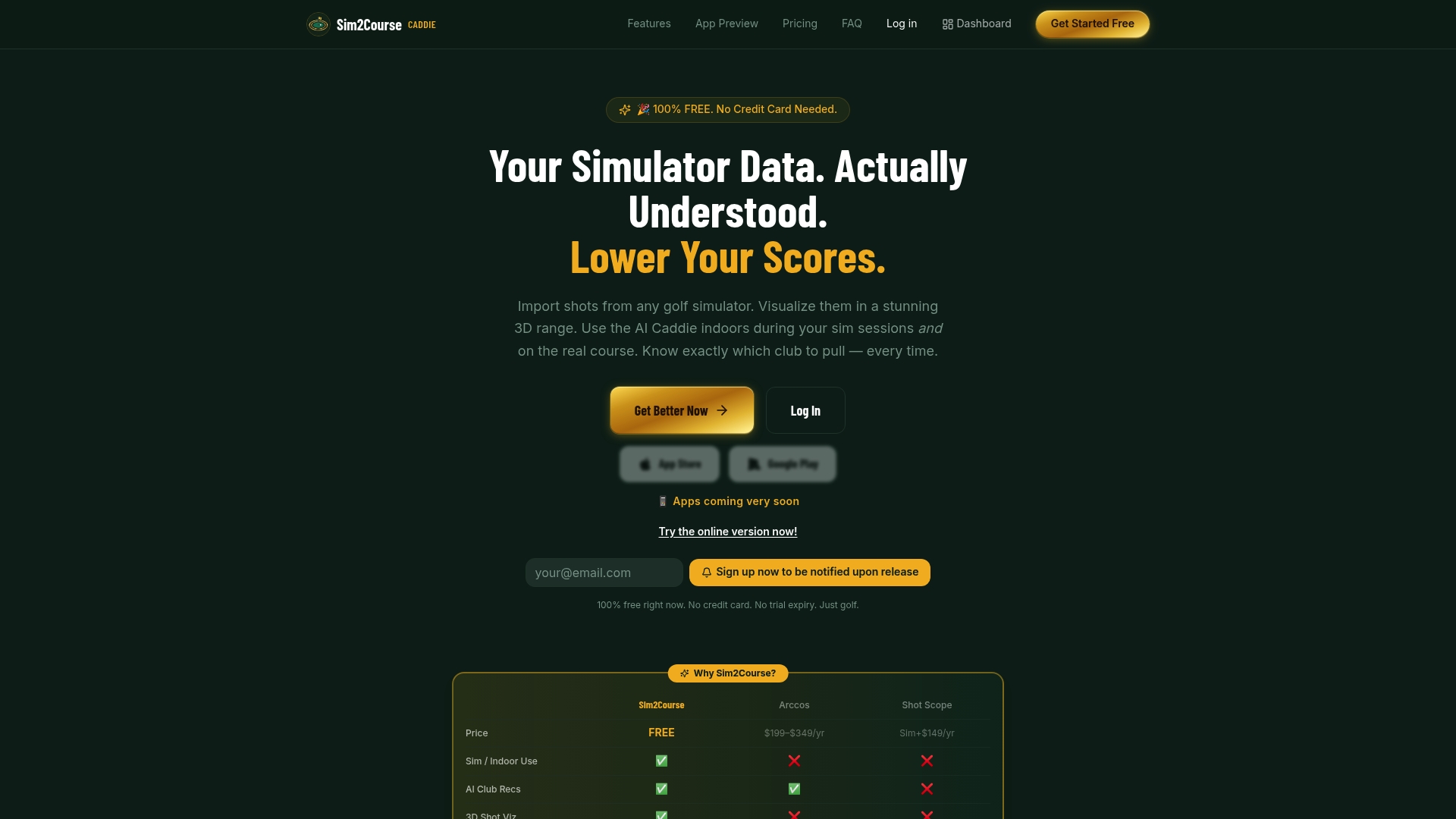
The app imports shot data from any golf simulator, removes the manual entry errors that corrupt most tracking systems, and presents your performance in a 3D driving range view that makes consistency patterns visible immediately. Its AI-driven club recommendations use your actual shot history, not generic averages, so the advice reflects your real game. Sim2coursecaddie is available free, with no hardware requirements and no subscription. If you are serious about finding and fixing your consistency killers, start tracking your shots with a system built to give you accurate data from the first session.
FAQ
What are the most common consistency killers in golf?
The most common consistency killers are grip pressure variation, swing plane deviation, weight transfer timing errors, ball position drift, and tempo variation. Data tracking across multiple sessions identifies which of these appears most frequently in your game.
How do data quality problems affect golf performance analysis?
Poor data quality, including duplicate records, manual entry errors, and silent sync failures, produces misleading performance insights. A golfer acting on bad data may practice the wrong fault for weeks without improvement.
What is eventual consistency in golf shot tracking?
Eventual consistency is a data model where all connected systems reach agreement on the same data after a short delay. Golf apps use this model for post-session analysis because it balances accuracy with speed without requiring real-time sync.
How many sessions of data do I need to identify a consistency killer?
A minimum of three to five sessions gives enough data to separate genuine patterns from random variation. Multi-session tracking is the only reliable way to confirm that a fault is a true consistency killer rather than a one-off error.
Does automating shot tracking actually improve data accuracy?
Automated tracking removes manual entry as an error source, which is the primary cause of data inconsistency in 64% of organizations using data systems. For golfers, automation means the data you review reflects what actually happened during your session.