
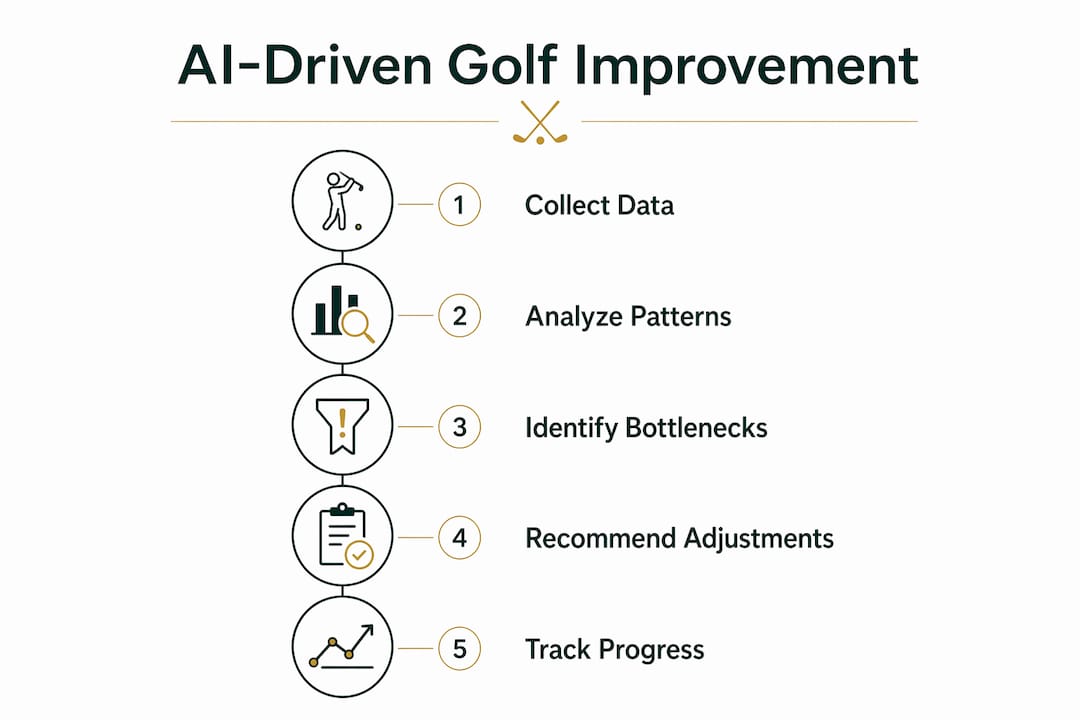
AI identifies improvement opportunities by analyzing large volumes of performance data to detect patterns, bottlenecks, and skill gaps that human review consistently misses. In golf, this process is called AI improvement analysis, and it works by feeding shot metrics, swing data, and training histories into machine learning models that surface non-obvious insights. Tools like Sim2coursecaddie apply these methods directly to simulator data, giving golfers a clear picture of where their game breaks down and why. Understanding how AI identifies improvement opportunities is the first step toward using it effectively on the course.
How AI detects growth areas: data and methods
AI detects growth areas by processing multiple data types simultaneously, including performance metrics, session histories, and behavioral patterns. No human analyst can hold hundreds of sessions in memory at once. AI can, and that scale is exactly where its advantage lives.
The core data types AI uses include:
- Shot metrics: carry distance, dispersion, launch angle, and spin rate across every club
- Session histories: timestamped logs of practice and play across weeks or months
- Behavioral patterns: how a golfer's decision-making and club selection shift under pressure
- Environmental context: course conditions, wind, and lie type that affect shot outcomes
Two methods drive most of the analytical power. Reinforcement learning with verifiable rewards increased AI agent performance from 15.6% to 71.0% on benchmark tasks. That result shows targeted behavioral improvement outperforms simply training a model on more raw data. The second method is meta-cognitive diagnostics, where the AI reasons about why a pattern exists rather than just flagging that it does.
AI also shifts performance analysis from reactive to proactive. AI uncovers hidden data patterns invisible to humans due to scale, moving organizations and athletes from fixing problems after they happen to preventing them in the first place.

Pro Tip: Feed your AI tool clean, consistent data. Inconsistent club labeling or skipped sessions create gaps that reduce the accuracy of every insight the model produces.
How does AI identify bottlenecks in golf performance?
AI identifies bottlenecks in golf by cross-referencing shot data across clubs, distances, and conditions to find the specific situations where performance drops. A golfer might feel confident with their 7-iron but not realize their dispersion doubles on approach shots from 160 yards under mild wind. Manual review rarely catches that. AI does.
Multi-session shot tracking uncovers player weaknesses invisible through single-session review. A pattern that appears once is noise. A pattern that repeats across 15 sessions is a real skill gap worth addressing. That distinction is where AI improvement analysis earns its value.
AI also catches systemic issues that feel unrelated on the surface. When AI processed 100,000 customer service interactions, it found 34% of issues stemmed from onboarding challenges, a pattern human sampling missed entirely. The same logic applies to golf: the root cause of a scoring problem is rarely the shot that went wrong, but a habit embedded across dozens of sessions.
The table below shows the difference between what golfers typically notice on their own versus what AI detects through multi-session analysis.
| Typical self-assessment | AI-detected opportunity |
|---|---|
| "My driver is inconsistent" | Dispersion increases 40% on holes with water left |
| "I miss putts under pressure" | Green-reading errors cluster on uphill left-to-right lines |
| "My short game needs work" | Wedge distance control drops sharply beyond 80 yards |
| "I struggle with long irons" | 4-iron and 5-iron contact degrades after the 12th hole |
Tracking multiple clubs reveals weaknesses that single-club analysis hides. A golfer who only tracks their driver misses the cumulative picture that shows where scoring strokes are actually lost.
What advanced AI frameworks drive continual improvement?
Continual improvement in AI relies on structured feedback loops, not one-time analysis. The AI agent lifecycle includes four phases: discovery, post-training, integration, and launch. Each phase feeds data back into the next, so the system gets sharper with every cycle rather than plateauing.
The steps in a well-designed AI improvement cycle look like this:
- Discovery: The AI collects baseline performance data across all tracked variables.
- Diagnosis: A reflector model reads error logs and reasons about why performance is low.
- Targeted adjustment: The system suggests specific fixes rather than broad changes.
- Integration: Updated insights are written back into the model's context for future sessions.
- Monitoring: Continuous evaluation tracks whether the fix held or created new gaps.
The reflector model is the critical piece. A reflector AI model that reads error logs and reasons about why performance is low provides more impact than feeding the model more data. More data without better diagnosis just produces more noise.
AI agents also suffer from a memory problem without proper design. AI agents start sessions stateless, causing repeated mistakes. Feeding extracted structured insights back into context files prevents repeating errors and improves learning efficiency. For golfers, this means the AI should carry forward what it learned about your game last month, not start fresh every session.
Switching the analytical framework itself can produce dramatic gains. Changing AI scaffolds increased model success rates from 46% to 80% without changing the underlying model. The lesson: how AI is structured around your data matters as much as the data itself.
Pro Tip: Review your AI tool's session summaries after every practice block, not just before tournaments. Patterns that emerge over four to six weeks give the model enough data to produce reliable root cause analysis.
What practical steps can golfers take to apply AI findings?
AI findings are only useful when they change behavior on the range and on the course. The gap between insight and action is where most golfers lose the benefit of their data.
Practical steps to apply AI-driven insights include:
- Prioritize the highest-frequency gap first. If AI shows your 150-yard approach dispersion is your biggest scoring leak, build your next three practice sessions around that distance before addressing anything else.
- Use club recommendation workflows before competition. AI club recommendations use data-driven analysis to improve tournament preparation and decision-making. Knowing which club performs best for you under specific conditions removes guesswork during play.
- Set measurable targets from AI baselines. If your AI analysis shows a 35-yard dispersion window with your 6-iron, set a goal to reduce it to 25 yards over six weeks. Concrete numbers make progress visible.
- Feed practice results back into the system. AI enables real-time performance adjustments, keeping optimization current rather than based on stale data. After each session, sync your results so the model updates its picture of your game.
- Act on longitudinal patterns, not single sessions. Longitudinal pattern recognition across multiple variables yields more reliable growth opportunity identification than single-trigger events. One bad round is not a signal. Ten rounds with the same miss pattern is.
Sim2coursecaddie applies these steps directly through its Range3D and Raw Data tools, which aggregate simulator data and surface the specific gaps most worth your practice time.
Key Takeaways
AI identifies improvement opportunities in golf by detecting patterns across multiple sessions that human review misses, making it the most reliable tool for finding real skill gaps.
| Point | Details |
|---|---|
| Multi-session analysis is essential | Single-session review misses recurring patterns; AI needs multiple sessions to identify real gaps. |
| Reflector models beat more data | Diagnosing why performance drops has more impact than feeding the AI additional raw data. |
| Feedback loops sustain progress | AI improvement compounds when session insights are written back into the model's context. |
| Club-specific tracking reveals weaknesses | Tracking multiple clubs uncovers scoring leaks invisible when only one club is analyzed. |
| Apply findings with measurable targets | AI insights only produce results when tied to specific, time-bound practice goals. |
Why AI surprised me about my own game
Most golfers assume they know where their weaknesses are. I did too. I was convinced my scoring problem was a weak short game. After running multi-session analysis through Sim2coursecaddie, the data told a different story: my approach play from 140 to 160 yards was leaking more strokes than anything inside 50 yards. I had been practicing the wrong thing for months.
That experience changed how I think about AI's role in performance. It is not a replacement for feel or course management. It is a correction mechanism for the blind spots that every golfer carries. The human brain is wired to remember the dramatic miss, the chip that lipped out, the three-putt. AI remembers the quiet pattern of slightly fat contact with the 8-iron that adds half a stroke per round, every round.
The common misunderstanding is that AI needs perfect data to work. It does not. It needs consistent data. A golfer who logs 20 sessions with honest, complete shot records will get more useful analysis than someone who logs 100 sessions with gaps and inconsistencies. Quality of input matters more than volume.
My honest advice: treat AI findings as a starting point for a conversation with your coach or practice partner, not as a verdict. The AI tells you what the pattern is. You and your coach figure out why it exists and how to fix it. That combination of machine pattern detection and human interpretation is where real improvement happens fastest.
— Jeff
Sim2coursecaddie puts AI analysis where you need it
Golfers who want to act on the AI methods described in this article need a tool that works with their existing simulator data, not against it.
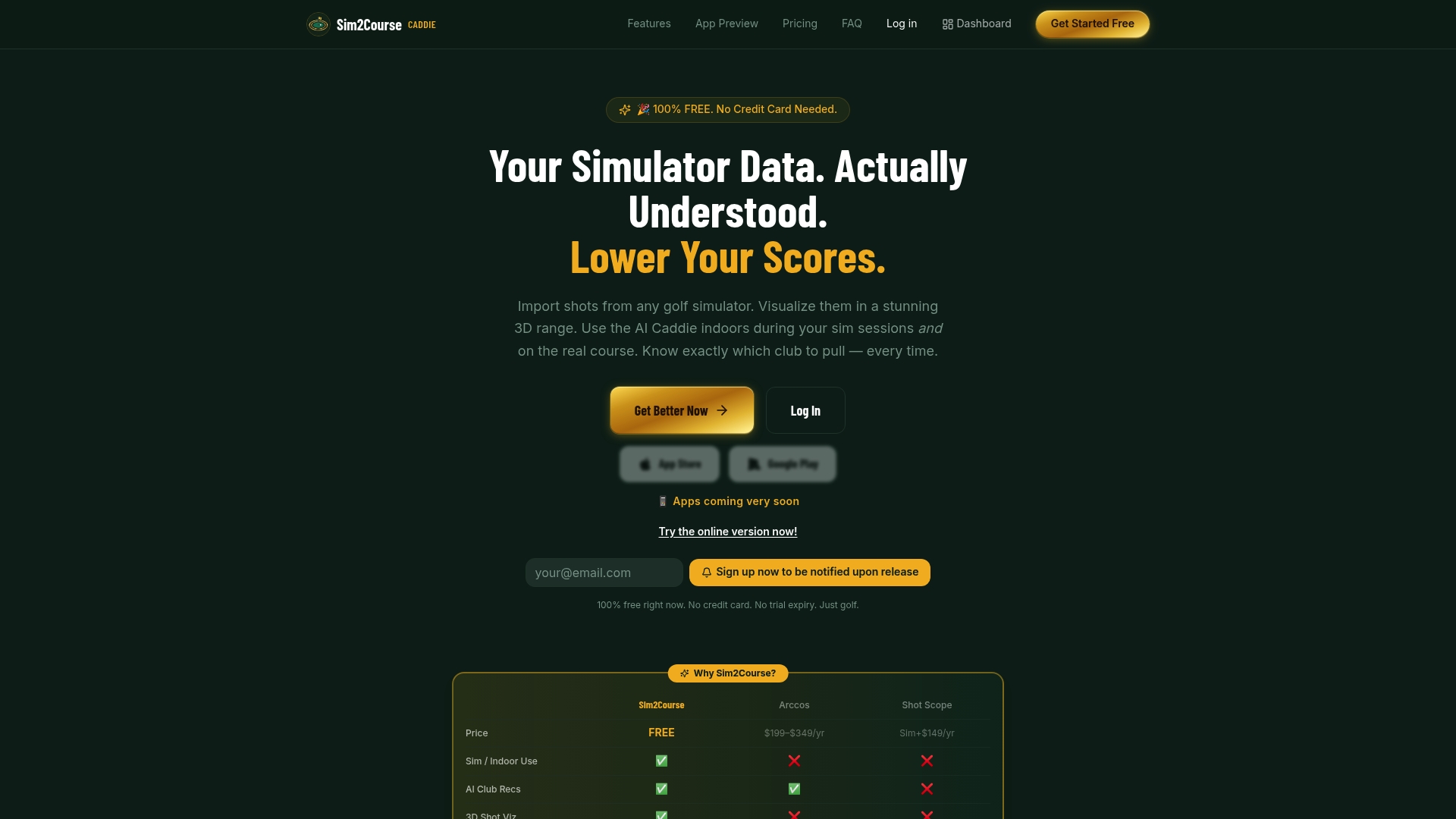
Sim2coursecaddie's Range3D visualizes your shot data in a 3D driving range environment, making it easy to see dispersion patterns and distance gaps across every club in your bag. The Raw Data analytics module goes deeper, giving you the session-level metrics that power genuine root cause analysis. Both tools are available free, so there is no subscription barrier between you and the insights your game needs. Import your simulator data, let the AI surface your real improvement areas, and take a focused plan to your next practice session.
FAQ
How does AI identify improvement opportunities in golf?
AI identifies improvement opportunities in golf by analyzing shot metrics, club usage patterns, and multi-session histories to detect recurring skill gaps and performance drops that manual review misses.
What data does AI need to analyze golf performance?
AI needs consistent shot data including carry distance, dispersion, launch angle, and session timestamps across multiple practice rounds to produce reliable improvement insights.
Is AI analysis better than working with a golf coach?
AI and coaching work best together. AI detects patterns across large datasets, while a coach interprets the root cause and designs the fix. Neither replaces the other.
How many sessions does AI need to find real patterns?
AI improvement analysis becomes reliable after multiple sessions because longitudinal pattern recognition across variables yields more accurate growth signals than single-session data.
Can AI recommendations improve tournament performance?
AI club recommendations use data-driven analysis to improve decision-making before and during competition, helping golfers select the right club for specific conditions based on their own performance history.