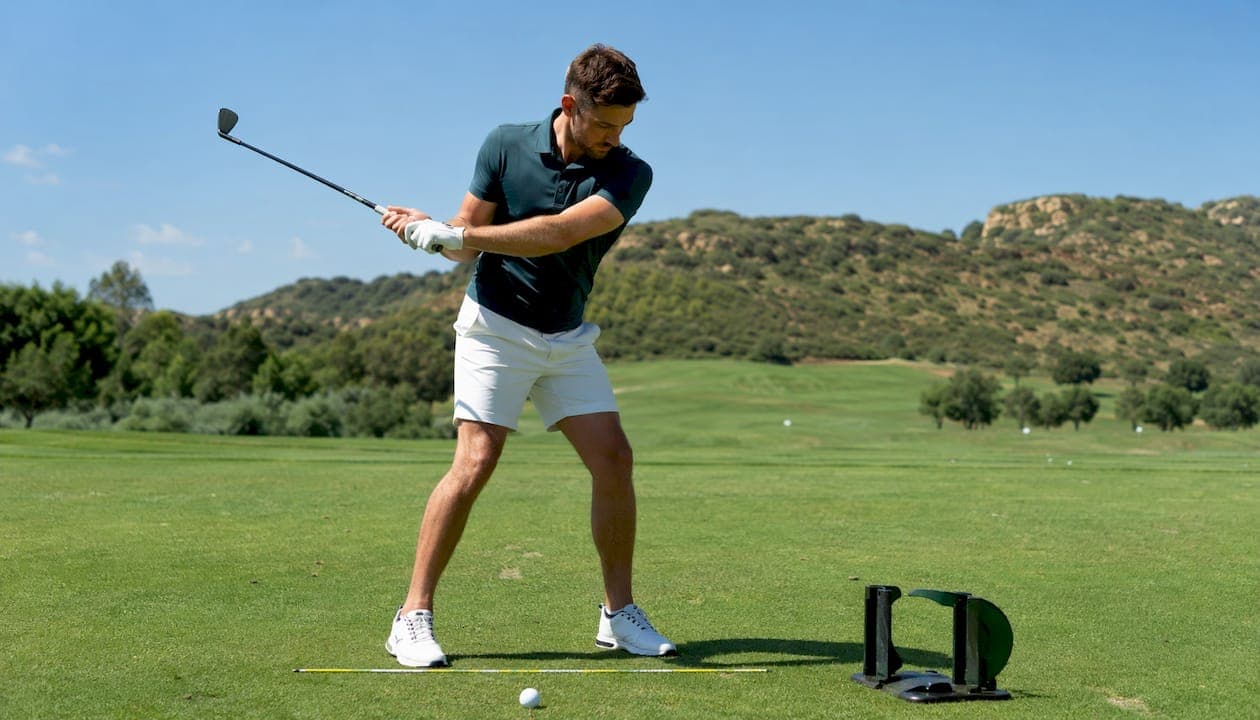
Club rotation driven from the pelvis in a proximal-to-distal sequence is the primary mechanical lever behind repeatable distance and efficient strikes. The fastest way to train it: targeted club-based rotational drills measured by simulator metrics in a baseline→intervention→measure workflow.
What to track first:
- Pelvic angular acceleration and peak-to-impact timing
- Torso–pelvis separation (X-factor) and clubhead speed
- Smash factor as your primary efficiency signal
Immediate action: Run a 20-shot baseline in Sim2coursecaddie, pick one RMT drill from Section 4, and commit to a 4-week measured block.
Table of Contents
- Why pelvic-led rotation is the engine behind every powerful swing
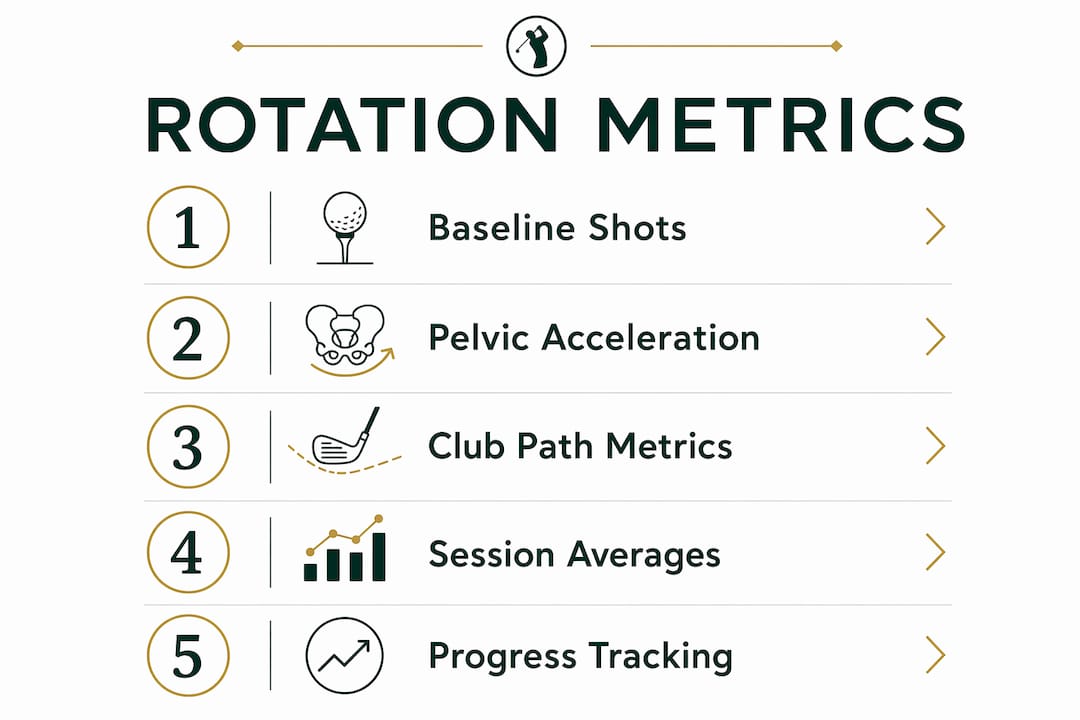
- Which simulator metrics reveal your rotational quality
- Practical club-based rotational drills (RMT) you can start this week
- A step-by-step simulator analytics workflow for measurable rotation gains
- Mobility, stability, and red flags: training rotation safely
- A measurable 6-week rotation practice plan for simulator golfers
- Key Takeaways
- Why the RMT-plus-simulator combination actually works
- Sim2coursecaddie makes the baseline→measure loop effortless
- Authoritative sources and further reading
Why pelvic-led rotation is the engine behind every powerful swing
Proximal-to-distal sequencing, starting at the pelvis, is how golfers generate transferable energy into the club. The pelvis fires first, the torso follows, and the forearms and club release last. Interrupt that order and you bleed speed before the ball ever sees the face.

The Golf Science Journal makes this concrete: elite golfers show higher average pelvic angular acceleration and longer peak-to-impact times, and those two kinematic measures correlate directly with higher smash factor and greater shot distance. The longer gap between peak pelvic velocity and impact is not wasted time. It is the window where distal energy transfer happens efficiently.
The same research recommends practicing pelvis and torso motion together rather than as isolated drills, because downswing movements are interdependent. Sequencing must be trained as a unit.
Key sequencing checkpoints:
- Pelvis initiates and reaches peak velocity before the torso
- Torso reaches peak velocity before the arms
- Club releases last, preserving the whip effect through impact
Pro Tip: Focus on a controlled pelvic drive into a short, unhurried club release. Trying to speed up the hands breaks the chain. Let the sequence do the work.
Which simulator metrics reveal your rotational quality
The metrics that map most directly to rotational quality are pelvic angular acceleration (or a proxy rotational acceleration reading), peak-to-impact timing, torso–pelvis separation (X-factor), clubhead speed, smash factor, and club-face rotation through impact.
| Metric | What It Measures | Direction of Improvement |
|---|---|---|
| Pelvic angular acceleration | Rate of pelvis rotation initiation | Higher = better sequencing |
| Peak-to-impact time | Gap between peak pelvic speed and contact | Longer = more efficient transfer |
| X-factor (torso–pelvis separation) | Rotational stretch at top of backswing | Larger = more stored energy |
| Clubhead speed | Terminal velocity of the club at impact | Higher = more distance potential |
| Smash factor | Ball speed ÷ clubhead speed | Higher values indicate a cleaner strike |
| Club-face rotation | Face angle change through the impact zone | Natural rotation = preserved leverage |
One practical note on club-face rotation: suppressing natural face rotation removes leverage and can cost roughly 7–8 mph of clubhead speed. Let the face rotate naturally through impact.
To reduce noise in your readings, use session averages and filter out clear mis-hits. Tracking misses systematically gives you a cleaner picture of where your rotation is actually breaking down.
Practical club-based rotational drills (RMT) you can start this week
Use club-based Rotational Movement Training drills that emphasize controlled pelvic acceleration and coordinated proximal-to-distal sequencing. RMT club training builds ambidexterity, transverse-plane strength, and CNS motor planning, all of which transfer directly to golf.
Core drill menu:
- Warm-up circles: Swing the club in slow, wide circles around the body. Intent: open the hips, activate thoracic rotation, decompress the shoulder joint.
- Single-arm pendulum swings: One arm at a time, half-swing tempo. Intent: isolate the pelvic drive without compensating with the trail arm.
- Half-rotation impact swings: Stop at impact position and hold for two seconds. Intent: groove the pelvis-leads-torso-leads-arms sequence at a speed you can feel.
- Weighted club deceleration drills: Swing to a controlled stop at follow-through. Intent: build eccentric rotational strength and protect the lumbar spine.
- Bilateral ambidextrous reps: Alternate lead and trail sides each set. Intent: address transverse-plane deficits that linear training leaves untouched.
Club swings create centripetal tractional forces rather than the compressive load of traditional lifts, which makes them safer for joint health during high-volume rotation work.
| Phase | Load | Sets × Reps | Focus |
|---|---|---|---|
| Light | Bodyweight/light club | 3 × 8 | Sequencing feel |
| Moderate | Standard club | 3 × 6 | Pelvic drive timing |
| Resisted | Weighted club | 3 × 5 | Transverse-plane strength |
| Sport-specific | Full swing tempo | 3 × 6 | Integration to full swing |
Train 2–3 sessions per week with at least one rest day between sessions. Start light and progress load only when sequencing feels clean.
Pro Tip: Keep your spine neutral throughout every drill. The moment you feel lumbar compression instead of rotation, reduce load or shorten the range of motion.
A step-by-step simulator analytics workflow for measurable rotation gains
Use a three-stage workflow: baseline measurement, focused drill intervention, and quantified re-test with pre-defined success criteria.
- Collect a clean baseline. Hit 20 shots with your target club (7-iron works well for most golfers). Filter out obvious mis-hits. Record mean clubhead speed, smash factor, and any rotational proxies your simulator provides. Session averaging is the single most important step for reducing day-to-day variance.
- Set a measurable target. Examples: pelvic acceleration proxy up 10%, peak-to-impact timing earlier by 0.03–0.05 seconds, smash factor from 1.42 to 1.46.
- Run the drill intervention. Two RMT sessions per week for four weeks. Keep one simulator session per week for tracking only, not for heavy practice.
- Re-test at week 4. Compare session averages, not single-shot peaks. A meaningful change is one that holds across the full 20-shot sample.
| Metric | Baseline (example) | Week 4 Target | Signal of Success |
|---|---|---|---|
| Clubhead speed | — | — | Consistent across session |
| Smash factor | 1.42 | 1.42 to 1.46 | Fewer outlier mis-hits |
| Session dispersion | ±8 mph | ±5 mph | Tighter standard deviation |
One pattern Jeff tracks in Sim2coursecaddie analytics notes: golfers who commit to the baseline→drill→re-test cycle for six weeks consistently show tighter distance dispersion alongside speed gains. The two improvements tend to arrive together when sequencing improves, not just raw effort.
Pro Tip: Plot a simple rolling 5-shot average during each session. If the average climbs across the session, your body is warming into the pattern. If it drops, fatigue is breaking the sequence. Stop before the pattern degrades.
Mobility, stability, and red flags: training rotation safely
Rotational training improves performance but must be paired with mobility and anti-rotation stability work to avoid overload. Steel club rotational training specifically addresses transverse-plane deficits that linear-only gym work leaves untouched, but it still requires a basic mobility screen before progressing.
Pre-training screening checklist:
- Hip internal rotation: can you rotate each hip 40+ degrees without pelvic tilt?
- Thoracic rotation: can you rotate your upper spine 45+ degrees each direction while seated?
- Pelvic stability: can you hold a single-leg stance for 10 seconds without lateral hip drop?
- Single-leg control: step-up with no knee cave on either side
Warmup sequence: Dynamic thoracic rotations → glute activation (clamshells or banded walks) → hip mobility swings → half-speed pendulum swings.
Cooldown: Gentle deceleration swings, 90/90 hip stretches, and thoracic foam rolling.
Red flags — stop and seek assessment if you experience:
- Sharp lumbar pain during or after rotation drills
- Asymmetrical hip symptoms (one side significantly tighter or painful)
- Acute shoulder pain at end range of the follow-through
Cross-sport rotational training research, including work on racquet and club sports, consistently shows that ambidextrous rotational work reduces asymmetry-related injury risk over time.
A measurable 6-week rotation practice plan for simulator golfers
A focused 6-week plan with twice-weekly rotational training sessions plus one simulator testing session per week yields measurable change for most golfers.
| Week | Focus | Session Structure | Measurable Goal |
|---|---|---|---|
| 1 | Baseline + drill intro | 20-shot baseline, introduce 2 drills | Establish baseline metrics |
| 2 | Sequencing feel | 3 × 8 light drills, 15 tracked swings | Consistent pelvic-first feel |
| 3 | Progressive load | 3 × 6 moderate drills, 20 tracked swings | Clubhead speed +1–2 mph |
| 4 | Reassessment | Full 20-shot re-test, compare to baseline | Smash factor trending up |
| 5 | Resisted work | 3 × 5 weighted drills, 20 tracked swings | Tighter session dispersion |
| 6 | Integration + final test | Full swing integration, 20-shot final test | Pelvic acceleration proxy up 10% |
Sample session plan:
- Warmup (5 min): thoracic rotations, glute activation, hip swings
- Drill block (15 min): 3 RMT drills at prescribed sets/reps
- Simulator block (10 min): 20 tracked swings, monitor one target metric in Sim2coursecaddie
- Cooldown (5 min): deceleration swings, 90/90 stretch
Translating rotational gains into on-course results also requires integrating shot data into club selection, not just tracking speed in isolation.
Key Takeaways
Pelvic-led rotation, trained with RMT drills and measured through a baseline→intervention→measure simulator workflow, is the most direct path to consistent distance gains and tighter shot dispersion.
| Point | Details |
|---|---|
| Pelvis leads the chain | Proximal-to-distal sequencing drives smash factor and distance; elite golfers show higher pelvic angular acceleration. |
| Five metrics to track | Monitor pelvic acceleration proxy, peak-to-impact timing, X-factor, clubhead speed, and smash factor every session. |
| RMT drills 2–3×/week | Train at light-to-resisted load progression; bilateral reps address transverse-plane gaps linear training misses. |
| Screen before you progress | Check hip rotation, thoracic mobility, and pelvic stability before adding load to rotational drills. |
| Sim2coursecaddie closes the loop | Use Sim2coursecaddie to run 20-shot baselines, track session averages, and apply AI-driven club recommendations after each training block. |
Why the RMT-plus-simulator combination actually works
Most golfers who struggle with rotation are not lacking effort. They are lacking feedback. You can grind through a hundred half-rotation drills and have no idea whether your sequencing improved, stayed flat, or quietly got worse under fatigue.
The combination of club-based RMT work and simulator analytics solves that. The drills build the neuromuscular pattern. The simulator tells you whether the pattern is showing up where it counts: at impact. Without the measurement side, you are training on feel alone, and feel is notoriously unreliable when the pattern is still forming.
Jeff's analytics notes from Sim2coursecaddie sessions show a consistent picture: golfers who track smash factor and session dispersion across a six-week block almost always see the two metrics move together. Speed climbs, and the spread tightens. That combination is the signature of better sequencing, not just harder effort. It is also the clearest sign that the training is transferring.
Sim2coursecaddie makes the baseline→measure loop effortless
Serious golfers already know the drills matter. What separates the ones who actually improve is whether they can see the change in the data. Sim2coursecaddie gives you that visibility without expensive hardware or a subscription.

Import your shot data from any simulator, pull up your rotational proxies and smash factor trends, and let the AI-driven club recommendations tell you which club to reach for based on your actual session data, not guesswork. The club recommendation workflow inside Sim2coursecaddie is built for exactly this: turning six weeks of rotation training into a concrete, data-backed equipment decision on the course.
Set up your first 20-shot baseline session at Sim2coursecaddie and run your first rotation training block with real numbers behind it.
Authoritative sources and further reading
- Golf Science Journal — Pelvic Kinematics Study: Rotational kinematics of the pelvis during the golf swing. Primary source for pelvic angular acceleration, peak-to-impact timing, and smash factor correlations cited throughout this article.
- IDEA Health & Fitness Association — RMT Club Training: Strengthen your programs with the Rotational Movement Training method. Supports drill selection, ambidexterity benefits, and CNS motor planning rationale.
- The Fitness Arsenal — Steel Club Training: Steel clubs: why rotational training is getting more attention. Frequency recommendations (2–3×/week) and injury-prevention rationale.
- Adex Clubs — Benefits of Club Training: Benefits of club training. Joint decompression mechanics and CNS pattern reprogramming.
- Rotary Swing — Club-Face Rotation: Club face rotation in the golf swing. Supports the 7–8 mph speed cost of suppressing natural face rotation.
- Sim2coursecaddie Blog — Drill Effectiveness Tracking: Drill effectiveness tracking: real examples for golfers. Practical session averaging and shot-filter methodology.
- Sim2coursecaddie Blog — Shot Data and Club Choice: How personal shot data informs club choice. Closing the loop between rotation gains and on-course club decisions.