
Directional bias in golf shots is a consistent, repeatable error where the ball starts or is aimed left or right of your intended line. It is not random. It shows up the same way, session after session, because it is driven by a systematic cause: a misaligned clubface at impact, a perceptual aiming error, or a recurring compensatory move in your swing. Here is what you need to know immediately:
- Start-line bias is where the ball actually launches relative to your target line. This is measurable in degrees and is the number that matters most.
- Perceived aim bias is where you think you are aimed versus where you are actually aimed. These two can compound each other.
- Curvature is a separate issue driven by the face-to-path relationship. Bias and curvature are not the same thing, and confusing them leads to the wrong fix.
The practical implication: a consistent directional bias shifts your entire miss pattern to one side. You cannot fix it by feel alone. You have to measure it.
Table of Contents
- What is directional bias in golf shots, exactly?
- What does the research say about aiming bias in putting?
- How does directional bias show up on the course?
- How do you diagnose your own directional bias?
- Drills and routines that actually reduce directional bias
- Common mistakes golfers make when diagnosing directional bias
- How Sim2coursecaddie helps you measure and track directional bias
- Key Takeaways
- Why measuring your misses beats trusting your feel
- Sim2coursecaddie makes the measurement protocol simple
- Useful sources
What is directional bias in golf shots, exactly?
The physics start with the D-Plane model. At impact, three variables determine where the ball goes: face angle, club path, and strike location. Of these, the clubface angle at impact is the dominant control point for the ball's initial horizontal launch direction. Modern launch-monitor data shows the ball starts predominantly toward the face angle, not toward the path. The path's primary job is to create the spin axis that produces curvature.

This distinction is the foundation of everything that follows. A directional bias is almost always a face problem, not a path problem.
Here is the core terminology you need:
- Face angle: — The direction the clubface points at impact, relative to the target line. This is the primary driver of start direction.
Think of it this way: if your ball consistently starts two yards right of your target before curving back, your face is open at impact. The path is secondary. If your ball starts on line but curves away, that is a face-to-path issue. Two different problems, two different fixes.
What does the research say about aiming bias in putting?
The evidence on directional bias is strongest in putting, where the variables are controlled enough to isolate perception from mechanics.
A peer-reviewed MDPI study measuring face angle and club path against initial launch found that horizontal launch direction generally clustered closer to the face angle than the path, with higher influence shown for drivers compared to irons and wedges, supported by player and robot test data. This is not a coaching opinion. It is controlled experimental data.
On the putting side, experimental work on directional aiming bias shows that stance, body orientation, and visual reference points produce systematic mis-aims that players cannot detect by feel. Golfers standing sideways to a target, as you do in putting, are particularly susceptible to perceptual errors that shift their perceived start line away from their actual start line. These are not random errors. They are robust, repeatable effects that show up consistently within subjects across trials.
Key finding from the research:
Players who relied on feel alone to assess their putting aim were systematically off-target in a consistent direction. The bias was not random noise. It was a predictable, measurable offset tied to stance and visual reference.
MIA Golf Technology's launch-direction analysis describes horizontal launch angle as the definitive metric for detecting start-line bias, with left recorded as negative and right as positive. The research-grade test methods behind these findings use controlled aiming tasks, within-subject designs, and launch-monitor measurements across multiple trials to separate true bias from shot-to-shot noise. That methodology is replicable on any modern launch monitor.
How does directional bias show up on the course?
The symptoms differ between putting and full shots, but the underlying pattern is the same: consistent misses to one side that do not feel like misses.
In putting:
- You consistently miss right or left of the hole on straight putts, even when pace is correct.
- Your lag putts cluster to one side of the hole rather than distributing evenly around it.
- You aim at the hole and feel confident, but the ball starts on a different line than you intended.
- Your alignment looks correct to you but looks off to a playing partner standing behind you.
In full shots:
- You hit a consistent push or pull that you have labeled your "stock shot" without ever measuring the face angle that produces it.
- Your dispersion pattern is not centered on the target. The centroid, the average landing point of your shots, sits left or right of where you aimed.
- You compensate with a path change (swinging more in-to-out to fix a push, for example) without addressing the face angle that started the problem.
The data metrics that reveal bias clearly are: horizontal launch angle (start line in degrees), face-to-target angle at impact, face-to-path (for curvature diagnosis), and dispersion centroid across a session. Tracking misses through data reveals patterns that feel-based practice simply cannot surface.
Pro Tip: Before you change your path, ask two questions: where did the ball start, and which way did it curve? If it started right and curved further right, you have both an open face and an outside-in path. If it started right and curved back left, your face is open but your path is fine. Face angle versus path at impact is a two-question diagnostic, not a one-answer fix.
How do you diagnose your own directional bias?
A reliable diagnosis requires a repeatable protocol. Here is one you can run at a range or on a practice green without specialized equipment, plus a launch-monitor version for precise measurement.
Simple range and putting green checks
- Alignment-stick baseline: Lay a stick on the ground pointing at a specific target. Address the ball normally, then have a partner check your clubface angle from behind. Do this for ten shots without changing anything. Note whether your face consistently points left or right of the stick.
- Multi-target start-line check: Hit ten shots at three different targets (left, center, right of the bay). Record where each ball starts relative to the intended line. A bias shows up as a consistent offset across all three targets, not just one.
- Two-person aim confirmation: Address the ball and freeze. Ask a partner to stand directly behind you and confirm where your face and body are aimed. The gap between your perception and their observation is your perceptual bias.
- Putting green rotation test: Putt ten balls from a straight six-foot putt in your normal stance. Then rotate your lead foot back slightly (open stance) and putt ten more. Compare where the balls start. A shift in start line between conditions confirms a stance-driven perceptual bias, replicating the methodology used in academic aiming-bias experiments.
- Chalk-line start-line drill: Use a chalk line or alignment tape on the practice green. Putt along the line and observe whether the ball tracks the line or departs left or right immediately after contact. Departure in the first six inches is a face issue; departure after that is a path or green-read issue.
Launch-monitor protocol
| Metric to record | Why it matters | Target sample size |
|---|---|---|
| Horizontal launch angle (degrees) | Direct measure of start-line bias | 25–50 shots per club |
| Face-to-target at impact | Confirms face angle contribution | Same session |
| Face-to-path | Separates curvature cause from start-line cause | Same session |
| Dispersion centroid (yards left/right) | Aggregate bias across the session | Calculated from full sample |
| Standard deviation of horizontal launch | Measures consistency, not just average bias | Same session |
Industry practice recommends a minimum of 25 shots per test condition to produce a stable centroid. Fewer shots produce noisy averages that can mislead you. A centroid offset of more than one degree of horizontal launch angle, sustained across 25+ shots, is a meaningful bias worth addressing. Less than that may be within normal shot-to-shot variation.
Drills and routines that actually reduce directional bias
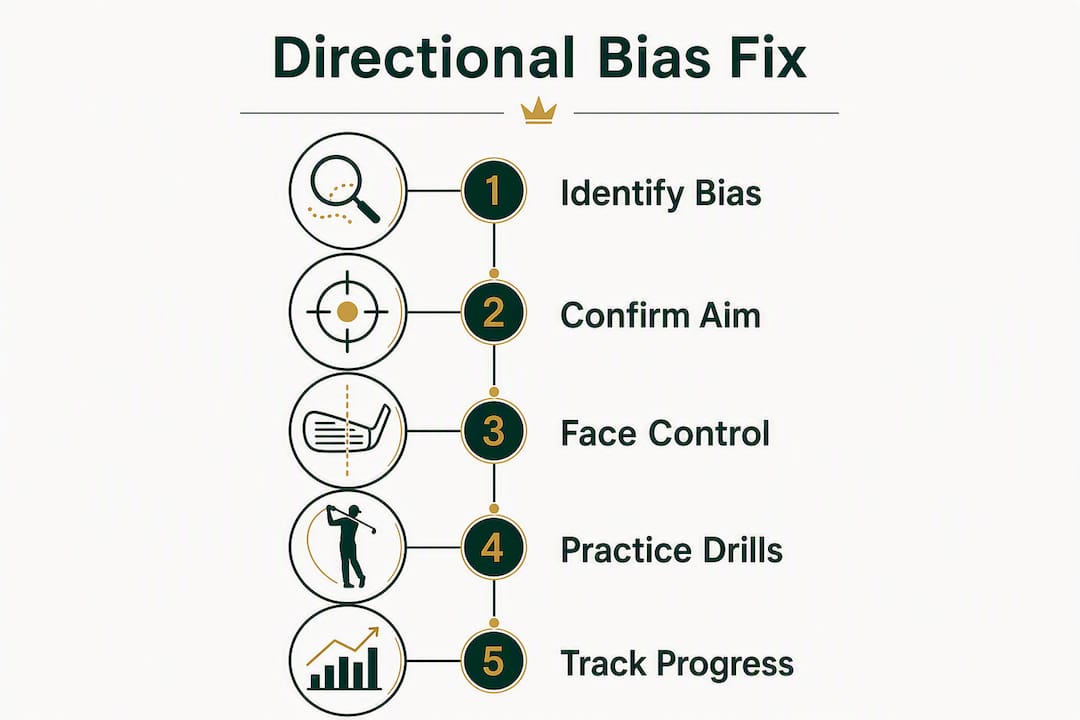
Fixing directional bias follows a sequence: correct the perception first, then the motor pattern, then validate with data. Jumping straight to swing changes without fixing your aim is one of the most common ways golfers make no progress for months.
Perception and aim drills:
- Mirror alignment check: Set up to a putt with an alignment rod on the ground pointing at the hole. Place a small mirror behind the ball facing you. Address the ball and look at the mirror to see where your face is actually pointing. Most golfers are surprised.
- Gate drill for putting: Place two tees just wider than the putter head on the intended start line. Stroke through the gate. If you consistently clip one tee, your face is open or closed at contact.
- Intermediate target routine: Pick a spot on the ground six inches in front of the ball on your intended start line. Aim the face at that spot, not the distant target. This reduces the perceptual distortion that comes from aiming at something far away while standing sideways.
Face control and strike drills:
- Toe/heel impact tape: Apply impact tape to the face. Hit ten shots and check where contact is occurring. Heel strikes add draw spin via gear effect; toe strikes add fade spin. If your impact location is consistently off-center in one direction, that is contributing to your bias independent of your face angle.
- Short-distance start-line practice: From ten feet, putt to a specific board or backstop and watch where the ball starts. No hole, no cup, just start line. Repeat 20 times and log the pattern.
- Alignment-rod mirrored putting: Place a rod on the ground along your intended start line and another rod along your feet. The angle between them reveals your stance bias. Adjust until both rods are parallel, then putt.
Progression plan: Spend the first two sessions on perception (aim confirmation, mirror work). Move to face-control drills in sessions three and four. Add center-face strike work in sessions five and six. Then run the full launch-monitor protocol again to compare your centroid before and after.
Course strategy while you fix it: If you know your bias runs two yards right, aim two yards left of your intended line until the data shows the bias has closed. Playing around a known bias is not a crutch. It is smart course management backed by your own numbers.
Pro Tip: Log your start-line data before and after every drill block. Without before/after numbers, you cannot tell whether a drill is working or whether you are just feeling different. Feeling better and hitting better are not the same thing.
Common mistakes golfers make when diagnosing directional bias
Several widely repeated ideas about ball flight and bias are wrong, and acting on them wastes practice time.
- "Path controls start direction." This is the most common misconception in golf instruction. Path controls curvature. The face controls where the ball starts. Launch-monitor data is unambiguous on this. If you are trying to fix a consistent push by swinging more in-to-out, you are working on the wrong variable.
- "More in-to-out will fix my slice." An in-to-out path with an open face still produces a push-slice. The face has to close relative to the path. Changing path without closing the face just changes the shape of the miss.
- "Alignment sticks solve my aim problem." Sticks fix your body alignment, not your face alignment, and not your perceptual bias. You can be perfectly aligned with your body and still have a face that is two degrees open at impact. Sticks are a starting point, not a complete solution.
- "Gear effect is minor." For golfers hitting heel or toe shots consistently, gear effect is not minor. It adds spin that can produce a hook or slice even when face/path numbers would predict a straight shot. If your launch-direction data does not match your face/path numbers, check your impact location.
- "I can feel where my face is pointing." Research on putting aiming bias shows that feel is systematically unreliable for detecting face angle. Players regularly report aiming straight when they are measurably off by several degrees. The fix is measurement, not more feel-based practice.
The corrective principle behind all of these: separate the variables. Start line tells you about the face. Curvature tells you about face-to-path. Impact location tells you about gear effect. Treat them as three separate diagnostics, not one combined problem.
How Sim2coursecaddie helps you measure and track directional bias
Here is a practical workflow using Sim2coursecaddie to run the baseline protocol described in this article and track your progress over time.
Session setup: Import your shot data from any launch monitor or simulator into Sim2coursecaddie. The app accepts data from any source, so you are not locked into specific hardware. Set your target line for the session before you begin hitting.
Metrics to log per session:
| Metric | Baseline session | After-drill session | Change |
|---|---|---|---|
| Centroid offset (yards left/right) | Record from 3D view | Re-measure after drill block | Target: closer to zero |
| Mean horizontal launch angle (degrees) | Average across 25–50 shots | Same sample size | Target: reduced absolute value |
| SD of horizontal launch | Baseline variability | Post-drill variability | Target: reduced |
| % of shots inside ±1° corridor | Baseline percentage | Post-drill percentage | Target: increased |
App features that make this concrete:
- 3D dispersion view: Sim2coursecaddie's Range3D visualization plots every shot in three dimensions. You can see immediately whether your centroid sits left or right of the target line, and by how much. This is the visual confirmation that removes guesswork.
- Session comparison: Run a baseline session, complete a drill block, run a second session, and compare the two side by side. The centroid shift between sessions is your measurable improvement.
- Club-by-club centroids: Tracking multiple clubs reveals whether your bias is consistent across the bag or specific to certain clubs. A bias that only shows up with the driver but not the 7-iron points toward a club-specific face-control issue, not a global aiming problem.
Pro Tip: Structure your test sessions cleanly: ten warm-up shots that do not count, then 25–50 shots in randomized target order with consistent tee height. Randomizing targets prevents you from unconsciously adjusting between shots, which would contaminate the centroid data.
Key Takeaways
Directional bias is a face-dominant, measurable start-line error that requires data to diagnose and validate. Feel-based practice alone will not fix it.
| Point | Details |
|---|---|
| Face controls start direction | The clubface at impact determines roughly 75–85% of horizontal launch direction, not the swing path. |
| Measure before you fix | Run 25–50 shots per club and record horizontal launch angle to establish a real centroid before changing anything. |
| Separate the variables | Start line reveals face issues; curvature reveals face-to-path issues; impact location reveals gear effect. Treat them as three distinct diagnostics. |
| Validate every drill with data | Compare centroid offset and standard deviation of horizontal launch before and after each drill block to confirm real improvement. |
| Sim2coursecaddie tracks the protocol | Import session data, view 3D dispersion centroids, and compare before/after sessions to prove bias reduction with numbers. |
Why measuring your misses beats trusting your feel
The golfers who improve fastest are not the ones who practice the most. They are the ones who practice with the clearest feedback loop. A consistent directional bias of even one degree in horizontal launch angle compounds across a round. On a 150-yard approach, one degree of start-line error puts the ball roughly 2.6 yards offline before any curvature. Over 18 holes, that is the difference between attacking pins and scrambling from the fringe.
What I find most underestimated in this conversation is how confident golfers feel about their aim when the data says otherwise. The putting research is particularly striking here: players who were systematically mis-aimed reported feeling correctly aimed. That gap between perception and reality does not close through more practice. It closes through measurement. Running the diagnostic protocol in this article with one club this week, logging the centroid, and comparing it to your perceived target line is the single most useful thing you can do before your next range session.
Sim2coursecaddie makes the measurement protocol simple
Most golfers know they have a bias. Few have ever measured it. Sim2coursecaddie gives you the tools to run the exact protocol described in this article without additional hardware or a coaching appointment.

Import your shot data from any simulator or launch monitor, pull up the 3D dispersion view, and your centroid offset is visible immediately. The free analytics tier covers everything you need for baseline measurement: horizontal launch visualization, session logging, and club-by-club dispersion. The Pro subscription ($1/month or $9.99/year) adds live GPS caddie features and real-time club recommendations, which become genuinely useful once you know your bias and want to account for it on the course.
Getting started takes three steps: sign up for free golf simulator analytics at Sim2coursecaddie, import one session from your last range visit, and check where your centroid sits relative to your target line. That single number tells you more about your directional bias than a month of feel-based practice.
Useful sources
- Directional aiming bias in golf putting (PubMed) — peer-reviewed experimental study on systematic aiming errors in putting; best for understanding the perceptual basis of bias.
- Directional Bias and Environmental Cues in Golf Putting (Golf Science Journal) — exploratory study on how environmental cues influence putting start direction; useful for replicating aiming-bias experiments.
- The influence of face angle and club path on resultant launch angle (MDPI) — primary experimental source for horizontal launch ratios (76% driver, 69% 7-iron); best for method replication.
- Launch Direction: Horizontal Launch Angle (MIA Golf Technology) — practical guidance on measuring start line and interpreting launch-monitor data; recommended for protocol setup.
- What is Launch Direction? (Titleist Learning Lab) — clear explanation of how launch direction is measured and why it is the correct metric for detecting bias.
- Face Angle vs. Path at Impact (Foy Golf Academy) — practical coaching breakdown of the two-question diagnostic for separating face from path faults.
- D-Plane Explained: The Real Ball Flight Laws (Golf Guidebook) — accessible explanation of the D-Plane model and gear effect; good starting point for understanding the physics.