Most 3-hybrids carry a stamped loft between 19° and 21°, with 19° being the most common number you'll see on the sole. According to MyGolfSpy's hybrid loft guide, a 19° hybrid is typically labeled 3H and most often replaces a 3-iron, though it can overlap a 7-wood depending on your specific set makeup. The Mitchell Golf loft chart places the 3-hybrid in that same 19°–21° window, with typical mid-handicap carry bands running roughly 170–195 yards.
That stamped number, though, is only the starting point:
- Stamped loft tells you the club's static angle at rest, not what it does at impact.
- Head design, CG placement, and shaft length change how the club actually launches, even at identical stamped lofts.
- Your dynamic loft at impact depends on your attack angle and shaft lean, so two players hitting the same 3-hybrid can see meaningfully different launch and carry.
Measure your carry. Don't assume it from the number on the sole.
Key Takeaways
A 3-hybrid's stamped loft of 19°–21° is a starting point, not a performance guarantee: measured carry and dynamic loft at impact are what determine whether it belongs in your bag.
| Point | Details |
|---|---|
| Typical 3-hybrid loft | Most 3-hybrids are stamped 19°–21°; 19° is the most common 3H designation. |
| Replacement role | A 3-hybrid most often replaces a 3-iron and can overlap a 7-wood depending on set lofts. |
| Carry reference | Mid-handicap carry typically runs 170–195 yards, but your actual number requires measurement. |
| Measure, don't assume | Hit 30+ shots on a launch monitor, average the top 20 carries, and compare medians against adjacent clubs. |
| Sim2coursecaddie | Free analytics lets you import simulator data, compare club carry medians, and confirm your 3-hybrid fills a real gap. |
Table of Contents
- What the stamped loft number really means for your 3 hybrid
- Which irons and fairway woods does a 3-hybrid replace?
- How a 3-hybrid flies compared with a 3-iron and 7-wood
- Expected distances and how to measure your real gapping
- Should you carry a 3-hybrid? A practical decision checklist
- How to confirm a 3-hybrid fits your bag using launch data
- The verdict on 3-hybrid loft
- Why the data almost always changes your mind about the 3-hybrid
- Sim2coursecaddie gives you the carry data to make this call
- Sources
What the stamped loft number really means for your 3 hybrid
Static (stamped) loft is the angle between the clubface and a vertical line when the club sits at address. It's useful for cataloging and comparing clubs on paper. What actually determines your launch angle and spin is dynamic loft, which is the loft the face presents at the moment of impact. That number shifts based on how much shaft lean you carry into the ball, your attack angle, and your swing tempo.
Two players can hit the same 3-hybrid and see dynamic loft readings that differ by 3°–5°. The player who delofts aggressively through impact will get a lower, more penetrating flight. The player with a shallower, more sweeping delivery will launch it higher with more spin.
Several design factors compound this further:
- Center of gravity (CG): A lower, deeper CG promotes a higher launch and more spin for a given stamped loft. Hybrids are built with this in mind; long irons are not.
- Sole geometry: A wider, more rounded sole helps the club glide through turf and rough, which changes how consistently you can deliver the face.
- Face construction: Thin, flexible faces in modern hybrids add ball speed across a wider strike zone compared with blade-style irons.
- Shaft length and flex: Hybrids typically run 40–41 inches, shorter than fairway woods but longer than irons, which affects swing arc and the loft you present at impact.
A 19° hybrid and a 19° fairway wood share a number on paper. In practice, the wood's longer shaft, higher CG position, and shallower face produce a different launch window entirely. As Hireko Golf's hybrid comparison shows, brand spec charts often reveal these overlaps when you look at loft and length together.
Pro Tip: Don't trust the stamped number alone. Pull up the manufacturer's spec sheet and cross-reference with a launch monitor or simulator session before making any bag decisions.
Which irons and fairway woods does a 3-hybrid replace?
The short answer: a 3-hybrid most commonly replaces a 3-iron, and it can overlap a 7-wood depending on loft. But modern irons have generally strengthened across all categories, so the right replacement depends on the specific set in your bag, not a generic chart.
Carry bands are player-dependent starting references from the Mitchell Golf loft chart and GolfHub's 3-iron breakdown. Your actual numbers will vary.
A few things worth keeping in mind:
- A game-improvement iron set with a "3-iron" stamped at 18°–19° may already overlap your 3-hybrid, creating a redundant club.
- A players' iron set with a 3-iron at 23°–24° leaves a clear gap that a 19° hybrid fills neatly.
- The 7-wood sits in the same loft neighborhood as many 3-hybrids, so you're often choosing between them based on turf interaction and shot shape preference, not raw loft.
According to GolfWorks' analysis of loft and yardage, roughly half of the yardage difference between consecutive irons comes from loft changes and half from shaft length changes. That's why swapping a 3-iron for a 3-hybrid at a similar loft still produces a different distance: the hybrid's longer shaft and lower CG shift the carry window upward.
How a 3-hybrid flies compared with a 3-iron and 7-wood
The flight difference between these three clubs is real, and it matters for how you plan shots.
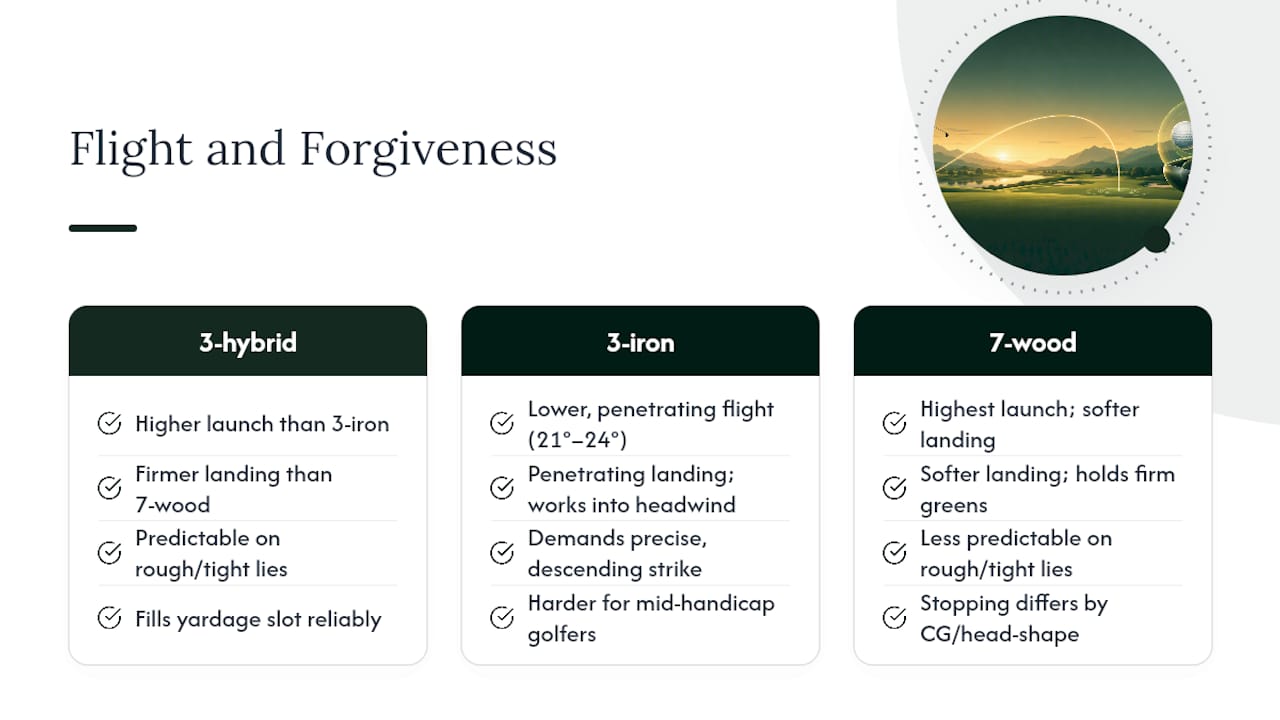
Versus a 3-iron: A 3-hybrid launches higher and with more spin than a 3-iron at a comparable stamped loft. The reason is CG placement. Hybrids position the CG lower and deeper in the head, which promotes a higher launch without requiring the player to help the ball up. A 3-iron's loft of 21°–24° produces a lower, more penetrating ball flight that works well into a headwind but demands a precise, descending strike to get the ball airborne consistently. Most mid-handicap golfers find the hybrid far easier to launch from a variety of lies.
Versus a 7-wood: The 7-wood typically launches higher with a softer landing angle, which is useful when you need to hold a firm green. The hybrid trades some of that height for better turf interaction. From rough, tight lies, or uneven ground, the hybrid's shallower sole and more compact head navigate contact more predictably than a fairway wood's longer, wider sole. MyGolfSpy's hybrid loft analysis notes that CG and head-shape differences between hybrids and woods explain why the same stamped loft produces different landing angles and stopping behavior.
Forgiveness and the playable miss: When you catch a hybrid slightly off-center, the larger face and perimeter weighting keep carry loss modest. A 3-iron punishes the same miss with a significant drop in both distance and height. That gap in forgiveness is why many golfers who struggle with long irons find the hybrid fills the yardage slot more reliably round after round.
Pro Tip: When you need a controlled, penetrating flight into the wind, test both your hybrid and your long iron on a launch monitor. Look at the spin and dynamic loft numbers, not just carry, to find which club gives you the shot shape you actually want.
Expected distances and how to measure your real gapping
Published carry ranges for a 3-hybrid sit around 170–195 yards for a mid-handicap player, per the Mitchell Golf loft chart. Those numbers are a starting reference. Your actual carry depends on swing speed, attack angle, ball contact, and the specific shaft in your hybrid.
Relying on published ranges to fill a yardage gap is how golfers end up with overlapping clubs or a 20-yard hole in their bag. The fix is straightforward: measure your own carry with a repeatable protocol.
- Hit at least 30 shots with the same ball, same tee height (if applicable), and the same ball position.
- Remove the obvious outliers at both ends.
- Average the top 20 remaining shots for a realistic carry number.
- Compare that median against your adjacent clubs (4-hybrid or 4-iron below, fairway wood above) to confirm the gap is 10–15 yards in each direction.
Tracking multiple clubs side by side is one of the fastest ways to expose gapping problems you didn't know existed. A single session comparing your 3-hybrid, 4-hybrid, and 5-wood medians will tell you more than any loft chart.
Statistic callout: The Mitchell Golf loft chart lists the 3-hybrid at 19°–21° with carry bands that vary by roughly 25 yards across player skill levels. That range is wide enough that two golfers with the same club can have completely different gapping needs.
Should you carry a 3-hybrid? A practical decision checklist
The 3-hybrid earns its spot in a bag when it fills a real yardage gap and performs better than the alternatives from your typical lies. Here's how to think through the decision.
Decision criteria:
- Do you have a consistent, repeatable carry in the 170–195-yard range that no other club covers cleanly?
- Do you frequently play from rough, tight fairway lies, or uneven ground where a long iron or fairway wood is harder to control?
- Does your current 3-iron (if you carry one) launch low and produce inconsistent carry, especially on off-center hits?
- Is your 7-wood or 5-wood already covering the same yardage window, creating overlap?
Quick yes/no checklist:
- Does your bag have a gap between your shortest fairway wood and your longest iron? (Yes = strong case for a hybrid)
- Can you launch a 3-iron consistently from rough? (No = hybrid wins)
- Does your 7-wood carry the same distance as your 3-hybrid would? (Yes = choose based on shot shape preference, not loft)
- Have you measured your carry with a launch monitor rather than estimating? (No = measure before deciding)
Common mistakes to avoid:
- Matching clubs by stamped number rather than measured carry. A "3-hybrid" from one brand can play like another brand's "4-hybrid."
- Ignoring dynamic loft. Your delivery angle changes what the club actually does, regardless of what's stamped on the sole.
- Keeping two clubs that carry the same distance because they have different numbers. Redundant clubs cost you a slot that could cover a real gap.
Building your bag around measured carry distances rather than club numbers is the approach that consistently produces better gapping decisions.
How to confirm a 3-hybrid fits your bag using launch data
Gut feel and published charts get you close. Measured data gets you there. Here's a repeatable workflow:
- Check static loft first. Use a loft/lie machine or the manufacturer's spec sheet to confirm the actual stamped loft. Adjustable hosels can shift loft by 1°–2° from the factory setting.
- Set up a controlled session. Same ball, same ball position, consistent swing intent. Tee height matters if you're testing off a tee.
- Hit 30+ shots. Fewer than 30 gives you too much noise to trust the median.
- Record the key numbers: carry distance, launch angle, dynamic loft at impact, spin rate, and lateral dispersion.
- Compare club medians side by side. Stack your 3-hybrid results against your 4-hybrid (or 4-iron) and your 5-wood. Look for clean 10–15-yard gaps in carry.
- Check dispersion. A club that carries 185 yards but scatters 40 yards left-to-right is not filling a gap reliably.
Dynamic loft is the number most golfers overlook. If your attack angle is steep, you're delofting the hybrid at impact and effectively turning a 19° club into something closer to a 16°–17° club in terms of launch behavior. A launch monitor exposes this immediately. Golf data analysis best practices recommend using spin rate alongside dynamic loft to confirm whether the club is launching in its intended window.
Pro Tip: Export your session data as a CSV and compare club medians in a spreadsheet. Sorting by carry median makes gapping gaps and overlaps obvious in seconds.
The verdict on 3-hybrid loft
A 3-hybrid typically carries a stamped loft of 19°–21°, most often replaces a 3-iron, and can overlap a 7-wood depending on your set's specific lofts. The stamped number is a catalog label. What determines whether the club actually fits your bag is measured carry, dynamic loft at impact, and how it performs from your most common lies.
- Stamped loft: 19°–21° (19° is the most common 3H designation).
- Replacement role: typically a 3-iron; potential overlap with a 7-wood.
- Carry reference: roughly 170–195 yards for mid-handicap players, but measure your own.
- Priority: measured carry and dispersion over any number stamped on the sole.
Measure. Don't assume.
Why the data almost always changes your mind about the 3-hybrid
Most golfers who come to a 3-hybrid decision already have a strong opinion before they test anything. They either love the hybrid because it feels easier, or they resist it because they think a long iron is the "real" shot. Both camps are usually surprised by what the data shows.
When you run a proper session comparing a 3-iron, a 3-hybrid, and a 7-wood side by side, the carry medians rarely land where you expected. The 3-iron often carries less than the player thinks, especially on the 60% of shots that aren't perfectly struck. The 7-wood frequently overlaps the hybrid by only 5–8 yards, which makes the choice between them a shot-shape and lie preference rather than a distance decision. And the hybrid, more often than not, fills the gap more consistently than either alternative from rough or uneven lies.
The other thing the data reveals is how much your attack angle matters. Golfers who sweep the ball tend to get more out of a hybrid's CG design. Players who hit down steeply can actually compress a long iron more effectively and get comparable carry with a lower, more controlled flight. Neither approach is wrong. But you won't know which one applies to you without the numbers.
That's the real argument for testing before deciding. Course management gets sharper when your club selection is built on what you actually carry, not what the chart says you should.
Sim2coursecaddie gives you the carry data to make this call
You now know what to measure. Sim2coursecaddie is the fastest way to run the workflow described above without booking a fitting appointment or paying for a TrackMan session.

Import your simulator data from any launch monitor, view your 3-hybrid shots in a 3D driving range, and compare carry medians across clubs in one place. The free analytics tier shows you dispersion, distance trends, and gapping gaps immediately. The Pro plan ($1/month or $9.99/year after a 14-day trial) adds live GPS caddie features and AI-driven club recommendations tied to real course conditions, so the carry numbers you measure in practice translate directly to on-course decisions.
Compatible with data from any golf simulator or launch monitor. No additional hardware required. Start with the free analytics and see whether your 3-hybrid is actually filling the gap you think it is.
Sources
- Hybrid Lofts Explained: Which Hybrid Replaces Each Iron And Fairway Wood?
- Golf Club Loft Chart - Every Club, Every Degree (2026)
- The Loft Angle of a 3 Iron Explained - The Golf Hub
- Hybrid Confusion? Golf Club Differences Explained | Hireko Golf
- How iron head loft affects your game